

As Benjamin Netanyahu’s sixth government enters its twilight, the most extreme elements of the settler movement, emboldened by a coalition packed with ultra-nationalists and messianic ideologues, are increasingly out of control. Yet the Israeli prime minister and his ministers remain largely silent. There can hardly be any good news in the face of terrorists attacking innocent Palestinians simply for being Palestinians and destroying their property. But bear with me for a moment as I attempt to enter the distorted mindset of those seeking to set the occupied West Bank ablaze — quite literally — and suggest that there might be a light at the end of this very dark tunnel.
For much the same reason that Netanyahu is keen to resume the war with Iran, those resorting to terrorism in the West Bank are doing so, whether consciously or not, because they recognize their time is running out. A new government is likely to be formed soon, one that it is hoped will no longer tolerate this criminally abhorrent behavior. Hardcore settlers appear to believe that only by setting the occupied West Bank on fire — and, in Netanyahu’s case, the entire region — can they manufacture an emergency that might delay the inevitable.
There is, however, a second silver lining. For the first time, we are hearing leading figures from the opposition camp, including Gadi Eisenkot, who could soon become prime minister, and Naftali Bennett, who previously served as director-general of the Yesha Council, call these attacks what they are: terrorism. This, in turn, obliges them to curb the assaults from the day they assume office.
Only they can explain why it has taken them so long to state what should have been obvious from the outset: that these are acts of terrorism. The commonly accepted definitions of terrorism or terrorist acts include the threat or actual use of violence to advance a political, religious, racial or ideological cause, targeting individuals or property and endangering lives, or putting the health and safety of the public, or a section of it, at risk. Can there be any doubt that this is precisely what those settlers who have been attacking Palestinian communities for years are seeking to inflict?
Hardcore settlers appear to believe that only by setting the occupied West Bank on fire can they manufacture an emergency that might delay the inevitable
Yossi Mekelberg
The distinction often made between attacks by Palestinians against Jewish civilians, which most Israelis readily recognize as acts of terrorism, and attacks by Jews against Palestinians reveals an extraordinarily “flexible” sense of morality, if not outright racism. The intervention by Defense Minister Israel Katz, who argued that an act can be defined as terrorism only if it is directed against a state, and that therefore the settlers’ violence does not qualify, even if their behavior is condemnable, is baseless. It also reflects how this government has become an enabler of settler extremism.
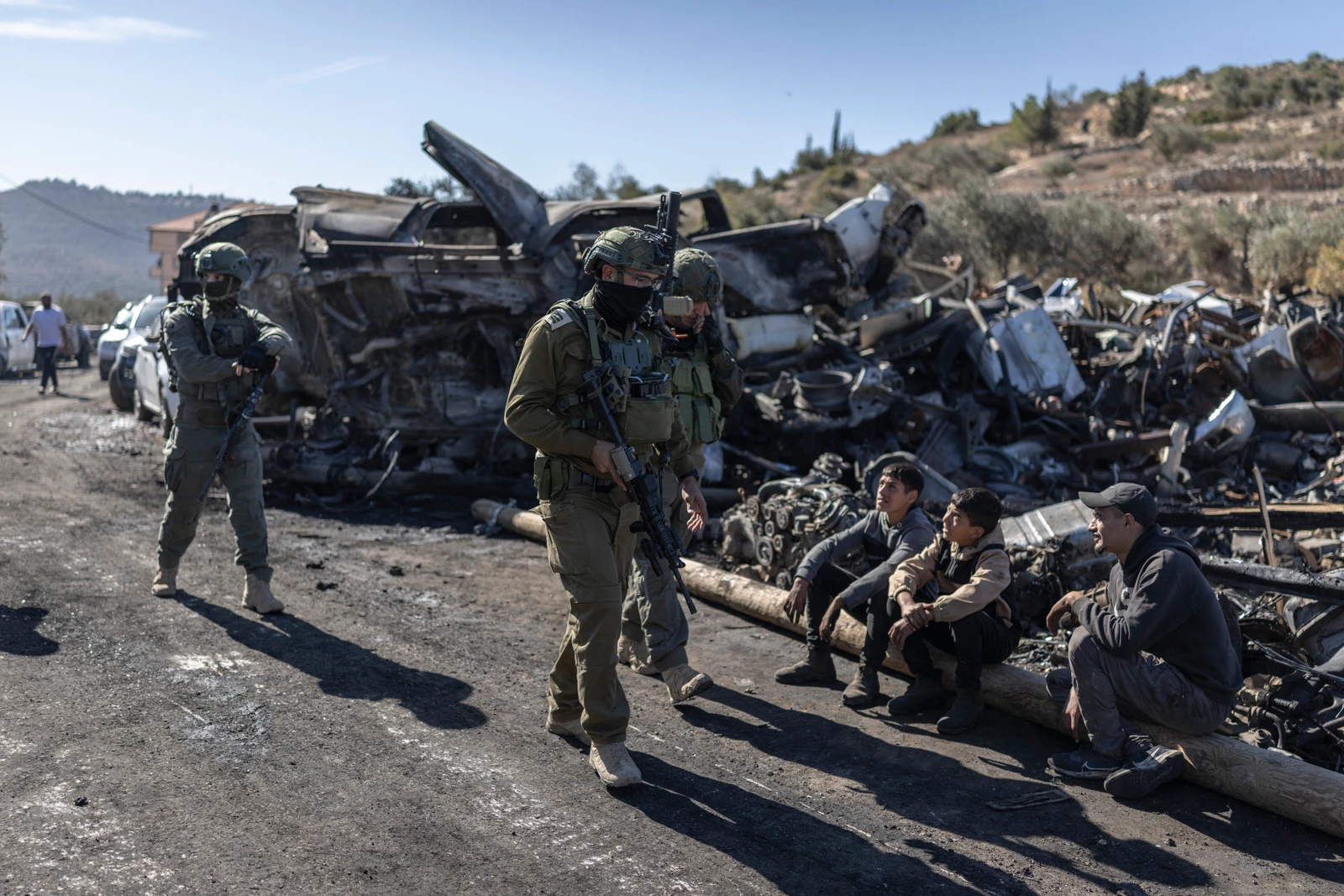
The images from last weekend were nothing short of horrific. Dozens of Israeli settlers carried out raids on Palestinian villages and towns across the West Bank, setting fire to at least a dozen vehicles and several homes. It was only by sheer luck that no lives were lost.
Eisenkot was right to point out that “extremist groups that set fire to vehicles and homes are undermining regional stability, putting lives at risk, and doing grave damage to Israel’s national security and foreign relations.”
Nevertheless, these acts of terrorism, carried out with almost complete impunity, go far beyond damaging Israel’s security and its relations with the rest of the world, which are already in free fall. They eat away at the soul of the country, undermine its claim to be a democratic state committed to universal human rights, and compromise the vision that many of the founders of the idea of a Jewish state had in mind.
In this context, Israeli President Isaac Herzog’s intervention in condemning Jewish extremism was also welcome. He described the attacks not only as “despicable” but also an assault “on God itself.” A further, and particularly significant, intervention came earlier this week from the President of the High Court of Justice, Yitzhak Amit, and two of his colleagues. They delivered a scathing criticism in court of the Israeli security forces’ handling of violence by settlers against Palestinians in the occupied West Bank. They instructed the military’s central command chief, Maj. Gen. Avi Bluth, and the police’s West Bank district command to submit sworn affidavits by the following week, detailing the practical steps they intend to take to curb the violence.
These interventions matter because they come from influential figures in positions of authority and occurred almost simultaneously. They suggest that there is growing recognition across Israeli society that this lawlessness must end — something that a new government may finally be prepared to address, in stark contrast to the current government’s moral numbness and tone-deafness to the consequences of its actions.
The international implications are becoming equally difficult to ignore. Only this week, US special envoy Jared Kushner, who has the ear of the US president, said that Israel is in danger if it fails to make the right decisions and continues along its current trajectory, potentially acquiring the status of a global pariah. These are particularly significant warnings coming from a Republican figure who has been exceptionally friendly toward Israel. Meanwhile, similar and often more critical voices are emerging from the Democrats’ elected representatives following their decisive victory in the midterm elections.
To this must be added the actions of two of Israel’s traditionally close allies. Earlier this month, the UK government sanctioned companies it said were involved in building settlements in the West Bank. This was the first package of measures since the government announced a tougher approach to Israeli actions in the territory back in September. Australia, meanwhile, announced further sanctions against individuals and organizations involved in what it described as “illegal settlement expansion and human rights abuses against Palestinians” in the West Bank. The international damage caused by the settlement enterprise in general, and by the terrorist minority within it in particular, is becoming clear.
One of the first and most urgent tasks of a new Israeli government — a government that does not include Netanyahu, Itamar Ben-Gvir, Bezalel Smotrich, and their ilk — is to put an immediate end to settler lawlessness. First and foremost, this is a matter of protecting Palestinian communities, and also restoring the authority of the state and its institutions, which are being openly challenged. In this upside-down reality, the violence is taking place under the protection of the military and with the support — or at least the acquiescence — of state resources.
A resolution to the Israeli-Palestinian conflict based on a two-state solution may not be around the corner. But the first step, before any serious discussion about such a solution and ending the occupation, must be to put a complete halt to the ugly phenomenon of extremist settlers dictating events and shaping the political conversation in the West Bank. Their influence extends far beyond the occupied territories. The rest of the country, through its government’s inaction, is increasingly seen as complicit.
Ending this lawlessness is not merely a political choice. It is a test of whether Israel still has the will to uphold the principles of democracy, the rule of law and basic humanity.
Yossi Mekelberg is a professor of international relations and an associate fellow of the MENA Program at Chatham House.
X: @YMekelberg


