
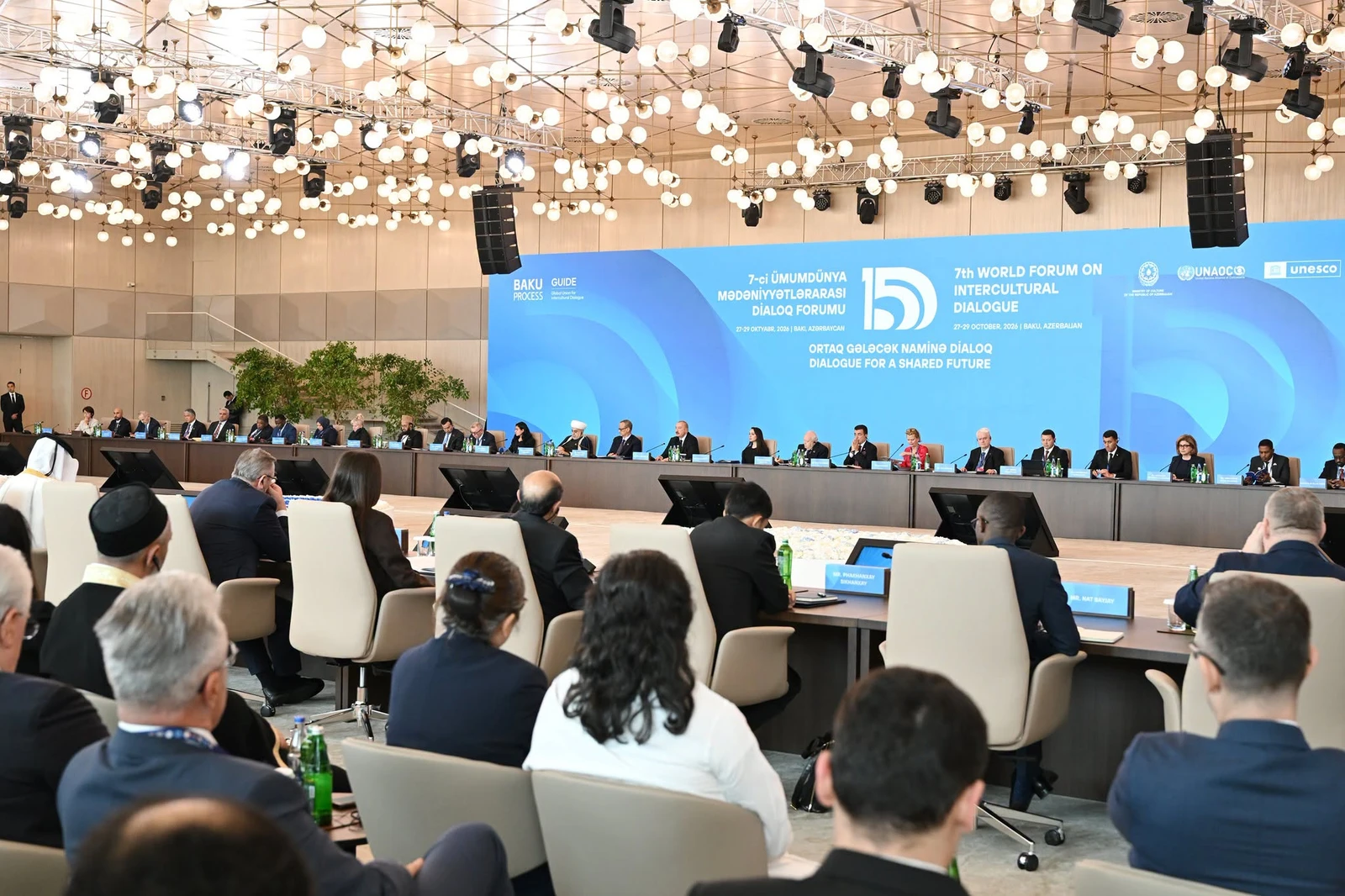

At the recent World Forum on Intercultural Dialogue in Baku, I heard Muslim leaders speak about Israelis and Palestinians with a balance too rarely heard in American public discourse.
They defended the rights and dignity of the Palestinian people while recognizing Israel’s right to live in peace. They spoke about Jews and Muslims as peoples whose futures are bound together. They presented coexistence as a religious and moral obligation rather than a political concession.
As an American rabbi who has spent more than two decades building Muslim-Jewish relations, I was encouraged by what I heard.
American perceptions of Islam are too often shaped by conflict, extremism and some of the most radical voices claiming to speak for Muslims. And too often in America, Muslim leaders discuss Palestinians’ rights at the expense of the Israeli state. The Muslim leaders I encountered in Baku represented another expression of Islam, one rooted in tolerance, mutual respect and understanding. Americans deserve to know it.
The seventh World Forum on Intercultural Dialogue, held under the theme “Dialogue for a Shared Future: Building Bridges in a Fractured World,” brought together political officials, religious leaders and representatives of international organizations. Azerbaijan created space for disagreements to be expressed without allowing those disagreements to become dehumanization.
The distinction matters most when discussing Israelis and Palestinians.
A Muslim need not become less Muslim, nor a Jew less Jewish, to recognize the humanity and dignity of the other.
Rabbi Marc Schneier
During the opening session, Organization of Islamic Cooperation Secretary-General Ismail Ould Cheikh Ahmed spoke about protecting Palestinian rights under international law. His message did not end there. He defined the two-state solution as recognizing the right of Palestine and Israel to live side by side in peace.
Americans need to hear this language from more Muslim leaders. Supporting Palestinian dignity does not require denying Jewish peoplehood. Recognizing Israel does not require indifference to Palestinian suffering. A just peace demands that we hold both peoples in our moral vision.
Dr. Salim bin Mohammed Al-Malik, director-general of the Islamic World Educational, Scientific and Cultural Organization, offered an equally important religious foundation. Quoting the Qur’an’s teaching that humanity was made into peoples and tribes so that we may know one another, he argued that cultural diversity should lead to deeper understanding and cooperation.
He spoke of spiritual values that affirm the sanctity of life and demand equal human dignity across national and religious differences. This was not Islam being softened for a Western audience. It was Islam speaking confidently from within its own tradition about the responsibilities of peace.
I have encountered this expression of Islam not only in Azerbaijan but also in Bahrain, Kazakhstan and the UAE.
In Bahrain, a historic synagogue stands in the center of Manama and the kingdom has made coexistence part of its national identity. In Kazakhstan, Muslim, Jewish, Christian and other religious leaders gather through the Congress of Leaders of World and Traditional Religions. In Abu Dhabi, the Abrahamic Family House gives Muslims, Christians and Jews distinct houses of worship within one shared complex.
These societies are not asking anyone to abandon religious conviction. They demonstrate a principle that has guided my work for decades: interreligious dialogue succeeds when no one is asked to leave their faith at the door. A Muslim need not become less Muslim, nor a Jew less Jewish, to recognize the humanity and dignity of the other.
This message is frequently overshadowed in the US. The loudest voices often receive the greatest attention, particularly when they reduce a complicated conflict to slogans, portray coexistence as betrayal or demand that Americans choose between concern for Palestinians and recognition of Israel.
The answer is not another shouting match. Americans should be introduced to Muslim leaders and societies that reject this false choice.
American rabbis, imams, pastors and educators should bring these examples into their congregations and classrooms. Muslim leaders from Azerbaijan, Bahrain, Kazakhstan and the UAE should be invited to address American audiences directly. Americans should hear how they reconcile strong Islamic identity with respect for Jewish life and approach the Israeli-Palestinian conflict without erasing either people.
The forum in Baku reminded me that the Muslim world is far more diverse than the version presented through America’s most polarizing debates. Muslim leaders are speaking honestly about Palestinian suffering while recognizing Israel’s right to exist. Muslim societies are protecting Jewish life. Muslims are advancing coexistence as an expression of faith.
Their voices deserve to be heard in America. Those of us who have heard them have a responsibility to bring their message home.
Rabbi Marc Schneier is president of the Foundation for Ethnic Understanding and founding senior rabbi of The Hampton Synagogue.


