
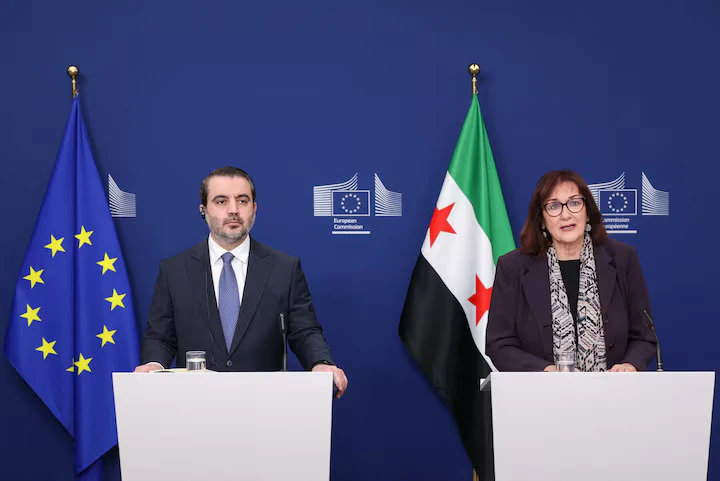

The EU on Monday took a major step to support Syria in recognition of Damascus’ transition moving forward in recent months. At its monthly meeting in Brussels, the EU Foreign Affairs Council decided on a “major upgrade” in its ties with Syria, in the words of EU High Representative for Foreign Affairs and Security Policy Kaja Kallas, moving ahead with the EU-Syria Association Agreement, which was concluded with Bashar Assad but never ratified or activated.
Ministers also decided to revive other earlier agreements with Syria, which were frozen when the Assad regime began its brutal campaign inside the country. About 13 million people were forced to leave their homes as a result, half of them fleeing across borders.
In the two years since the Assad regime was toppled, the EU has debated normalizing relations with the new Syrian government as it struggled to undo the destruction that the 13-year war had wreaked on the country. Syria could have used the EU’s help during those tough times but some member states preferred to wait as Damascus tackled a challenging economic recovery, national reconciliation, the reintegration of refugees and, worst of all, dealing with armed separatists resisting reintegration and the remnants of the old regime desperately clinging to power.
It is encouraging that the EU is now united in recognizing that a successful and speedy transition requires urgent help and full engagement from all of Syria’s friends, including the EU. A stable and strong Syria is of course in Europe’s interest. Investment, economic and humanitarian aid, security assistance and a structured political dialogue will accelerate Syria’s recovery and stabilization.
It is encouraging that the EU is now united in recognizing that a successful and speedy transition requires urgent help
Dr. Abdel Aziz Aluwaisheg
While some serious challenges remain, the Syrian government has managed to restore security and has stabilized the country. Its efforts in fighting terrorism and drug trafficking have been remarkable and its reconciliation efforts are to be commended, considering the enormity of the horrors of the war and the deep scars they left on Syrian society.
Today, the economic challenge may be the most daunting. Part of this is creating the right conditions for Syrians who fled the country to return. In a UN Security Council briefing on Monday, UN humanitarian officials stated that about 1.8 million refugees and 2 million people displaced inside Syria have voluntarily returned home since December 2024. This is about 30 percent of the total number of people who were made homeless during the war. To reabsorb the remaining 70 percent, the country needs help.
During the Syrian war, about 1.5 million refugees and migrants fled Syria and made their way to Europe, igniting a xenophobic backlash that continues today. Stopping that flow and helping refugees and migrants to return safely should be a priority for both sides. European investments could help Syria reabsorb them.
Syria and the EU share a long history of engagement at many levels. In 2010, the year before the war started, the EU was Syria’s top trading partner, accounting for about 22 percent of its total external trade. That trade eventually stopped during the last years of the Assad regime, due largely to sanctions. Now that European and American sanctions have been lifted, reestablishing trade and investment ties should not be insurmountable. Kallas said at the conclusion of Monday’s ministerial meeting: “Now we work in the working parties to sort out the technical and legal details, but we move forward with this.”
These encouraging steps coincide with signs that Syria’s engagement with the GCC countries is also moving forward
Dr. Abdel Aziz Aluwaisheg
These encouraging steps taken by the EU coincide with signs that Syria’s engagement with the Gulf Cooperation Council countries is also moving forward. During President Ahmad Al-Sharaa’s visit to Saudi Arabia this month, a defense cooperation accord was signed, together with several other agreements on energy, industry, development, health, housing and infrastructure. Syria has also signed a defense agreement with Turkiye and important economic deals with Qatar, Kuwait and the UAE.
NATO, on the other hand, is still debating whether to work collectively with Syria. No decision has been made due to the opposition of some of its members. However, important members of the organization are already engaging. Turkiye is cooperating with Syria on security, energy — including electricity and natural gas — reconstruction and infrastructure, including the rehabilitation of ports. The US has persuaded Syria to join the Global Coalition Against Daesh, making it the 90th member of the group. There has also been engagement between the two countries on security cooperation, including border security and counter-smuggling efforts.
France is also in discussion with Syria on security and counterterrorism cooperation, in addition to reconstruction and political transition support. The UK takes part in diplomatic contact groups and supports humanitarian assistance, recovery efforts and the political transition in Syria. Germany is providing humanitarian aid and supports reconstruction and refugee-related initiatives.
The Netherlands has allocated reconstruction and stability funding tied to supporting refugees’ return and political transition. Greece has also engaged with Syria on humanitarian support, civil protection and disaster preparedness, and getting rid of chemical weapons’ vestiges from the Assad era. The Czech Republic has also participated in humanitarian and development projects.
Last month, the GCC approved a comprehensive “plan of action” with Syria. Work on that plan started immediately after the new government took office in Damascus in December 2024, with a visit by the foreign minister of Kuwait, the GCC president at the time and the GCC secretary-general. Similar to the EU, the GCC used to have extensive engagement with Syria before the war but everything was frozen.
Now is the time to move forward on implementing this GCC-wide plan to complement and enhance the work of individual member states, such as Saudi Arabia, which has been extensive from Day 1. With the EU’s decision on Monday, the two blocs could partner to provide Syria with the security, economic and political support it needs.
Perhaps it is also time to revive support groups such as the Friends of Syria and the London 11. The former was set up in 2012, at France’s initiative, to help resolve the Syrian conflict while mobilizing humanitarian assistance. The London 11 was a smaller core group that included Saudi Arabia, Qatar, France, the UK and the US. It held high-level ministerial meetings for the same purpose. These two groups were instrumental in providing sustained humanitarian assistance to the Syrian people throughout the war. They can now be reconvened to help in the reconstruction. They could force multiply the collective EU-GCC efforts.
Dr. Abdel Aziz Aluwaisheg is the GCC assistant secretary-general for political affairs and negotiation. The views expressed here are personal and do not necessarily represent those of the GCC.
X: @abuhamad1


