
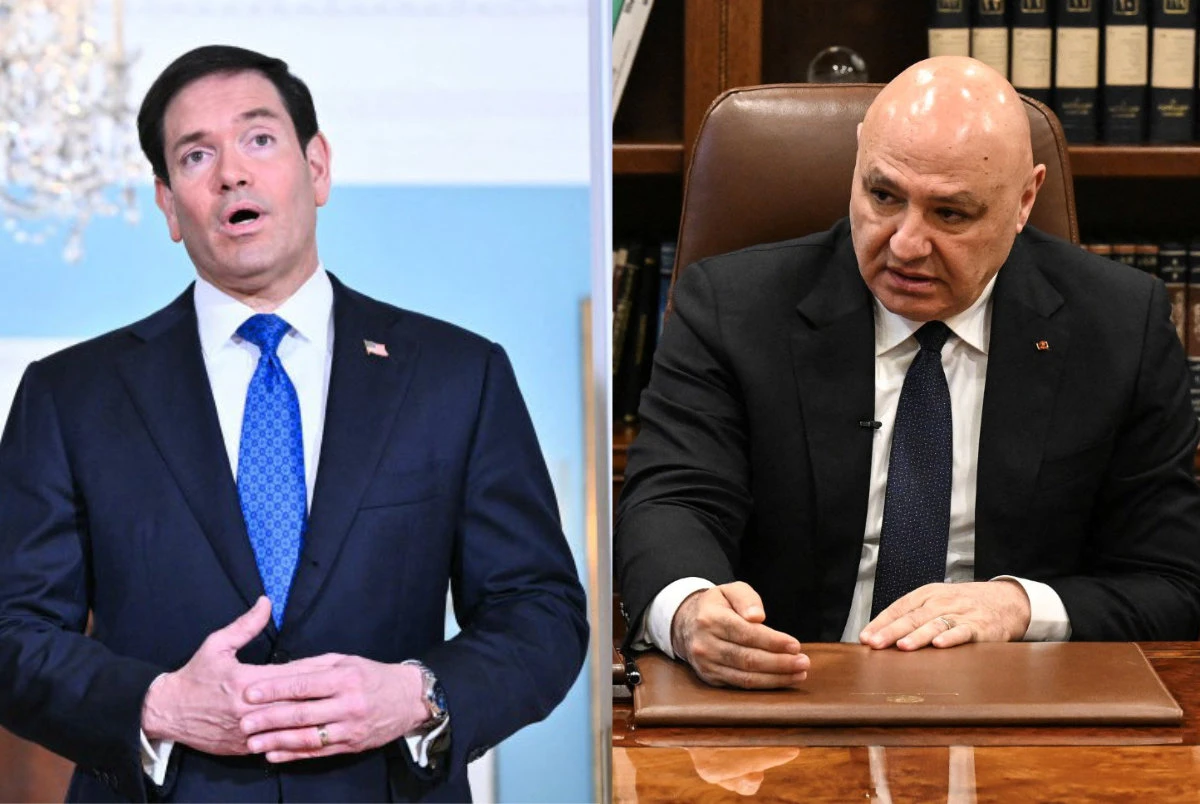

Marco Rubio pushed for and arranged this week’s trilateral military meeting between Israel, Lebanon and the US. The American secretary of state also called the Lebanese authorities and asked for clarification regarding the truck-load of explosives that was seized in the Bekaa area last week. Obviously, the US is pushing the Lebanese state toward greater rapprochement with Israel and a clash with Hezbollah — and this could be dangerous.
Following the seizure of the Hezbollah-linked explosives, Lebanese President Joseph Aoun called for “stricter enforcement” of weapons outside the authority of the state. He added that there should be “no leniency” for those “compromising the country’s stability.” After the truck was stopped, Hezbollah immediately called the authorities and asked them to hand it over. The group clarified that the explosives were part of their preparations for attacks by the Israeli enemy. Hezbollah lawmaker Hassan Fadlallah said the truck incident was a ploy to criminalize the group and drag its members to court.
The group has endured friction with the authorities before, notably last September, when it projected an image of assassinated leader Hassan Nasrallah on to Raouche Rock despite the opposition of the prime minister. However, such friction had been more or less contained and there have been calls recently for dialogue between Hezbollah and the government to clear the air. The Druze leader has said that such dialogue is necessary and possible. It is viewed as a way to reduce internal tensions amid relentless Israeli attacks.
The US has been displeased with the Lebanese government’s attempts to disarm Hezbollah. However, Washington has not empowered the Lebanese state. Disarmament is not a stand-alone activity. Disarming the group while it still has the loyalty of a large faction of the Lebanese people could lead to a clash, which is the last thing Lebanon needs.
The US has been displeased with the Lebanese government’s attempts to disarm Hezbollah
Dr. Dania Koleilat Khatib
But a clash would be very convenient for the Israelis. It would bog Hezbollah down in an internal confrontation. The US has been pushing the Lebanese state to confront the group but Beirut has so far avoided doing so. However, according to my sources, the truck incident has pushed the US to increase the pressure on the Lebanese government.
On top of this, the US asked the Lebanese army to meet the Israeli military. The US will decrease its representation, leaving the Lebanese army to coordinate directly with the Israelis at some point. The more the US sees that the Lebanese state is unable to disarm Hezbollah, the more it pushes Lebanon down the path of normalization with Israel. Lebanon is trying to push back while humoring Washington.
It was reported this month that Hezbollah had received $200 million in funding from Iran — although some sources say the true figure was more like $600 million — to support those displaced by Israel’s war on the south of the country. This is a big blow to the US, as well as to the Lebanese government it supports. It shows that sanctions are not working. Despite all the restrictions the government has placed on the ports, the borders and the airport, the group is still able to bring in money. The funds arrived at a time when the Lebanese government was failing miserably in its management of the crisis of the displaced.
In reaction to the news of the group disbursing aid to the displaced, the US is pressuring the Lebanese government to abolish the law that criminalizes contact between Lebanese and Israelis. This follows a call made by the Lebanese ambassador to the US to the Israeli ambassador to check on the latter’s son, who was hurt in an attack in the West Bank last month. The Israeli ambassador, as well as his son, are settlers. This led lawyers in Hezbollah circles to file a legal complaint against the Lebanese ambassador, as she allegedly breached the law prohibiting communication with Israelis.
There is no easy way to disarm Hezbollah. But the first step is to strengthen the Lebanese state
Dr. Dania Koleilat Khatib
However, anyone who knows anything about Lebanon’s structure knows that the US is pushing the state down a dangerous path. Unlike other armies in the region, the Lebanese armed forces are based on a delicate distribution of positions among the different sects. This is why, in May 2008, when Hezbollah attacked Beirut, the army stayed on the sidelines. There was a fear that if the army interfered internally to establish the authority of the state, it would splinter, as happened during the civil war.
The US should understand that there is no easy way to disarm Hezbollah. But the first step is to strengthen the Lebanese state. America can do that not by issuing empty statements but by pressuring Israel and forcing it to give a guarantee that, when the group disarms, it will withdraw from Lebanon. Instead of pushing Lebanon down this destructive path, the US should help the state offer a viable alternative to Hezbollah to the Shiite community. It should help the Lebanese state prove to the Lebanese people that it can guarantee their security and provide the basic services they deserve.
The transactional way the US is conducting politics with the Lebanese, by only applying pressure while offering no support, will not bear fruit. The proof of that is the funds Hezbollah sourced for distribution among the displaced and ultimately to the group’s supporters. If pushed into a corner by the US, the Lebanese state might very well look for an alternative to Washington rather than creating a full-blown clash with Hezbollah.
Dr. Dania Koleilat Khatib is a specialist in US-Arab relations with a focus on lobbying. She is co-founder of the Research Center for Cooperation and Peace Building, a Lebanese nongovernmental organization focused on Track II.


