- 57% of surveyed Americans say a candidate’s position on military involvement in Middle East is a factor in deciding their vote
- Views on Israel, Iran and Saudi Arabia expose partisan divide as Trump’s Republicans fight to retain control of Congress
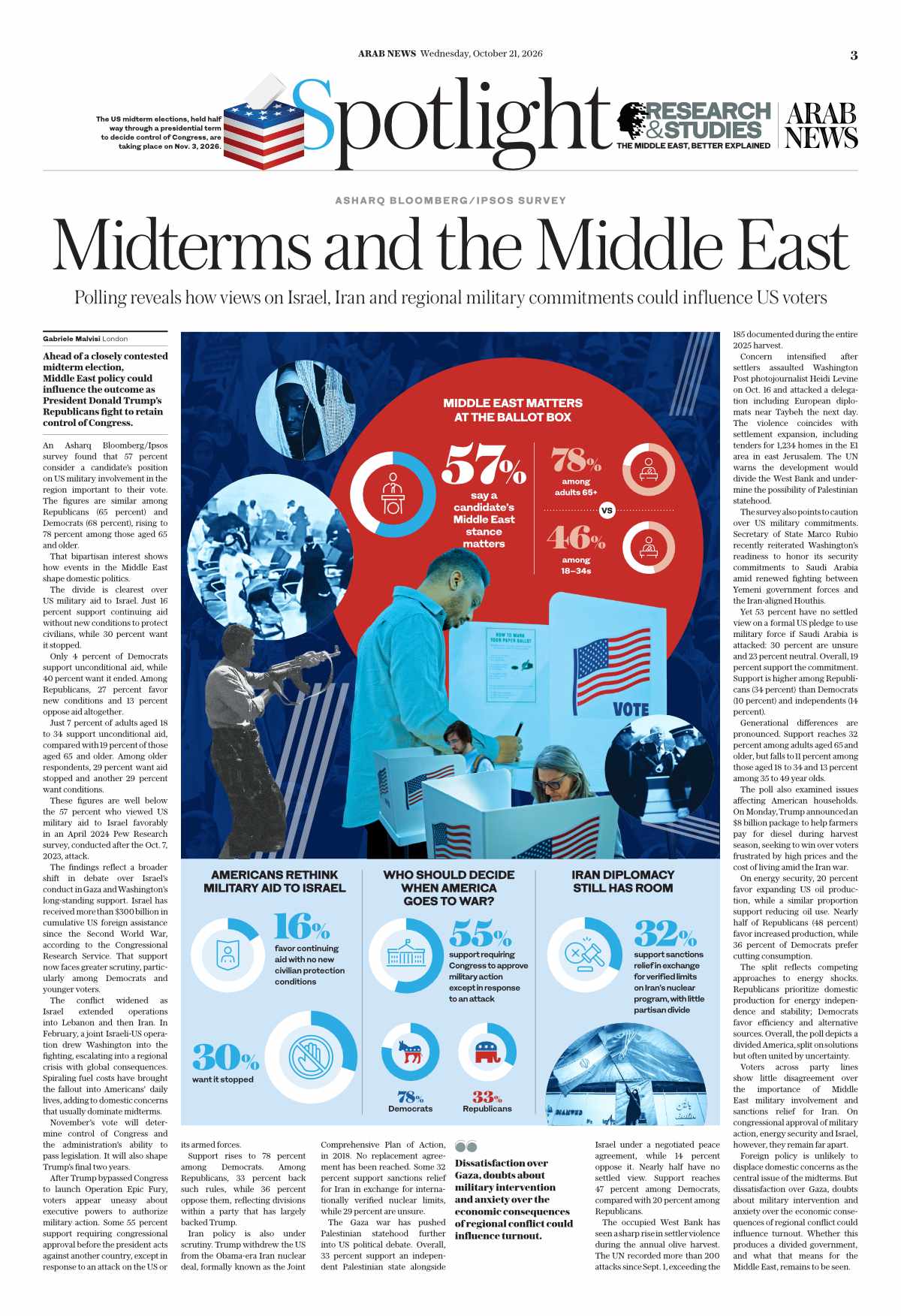
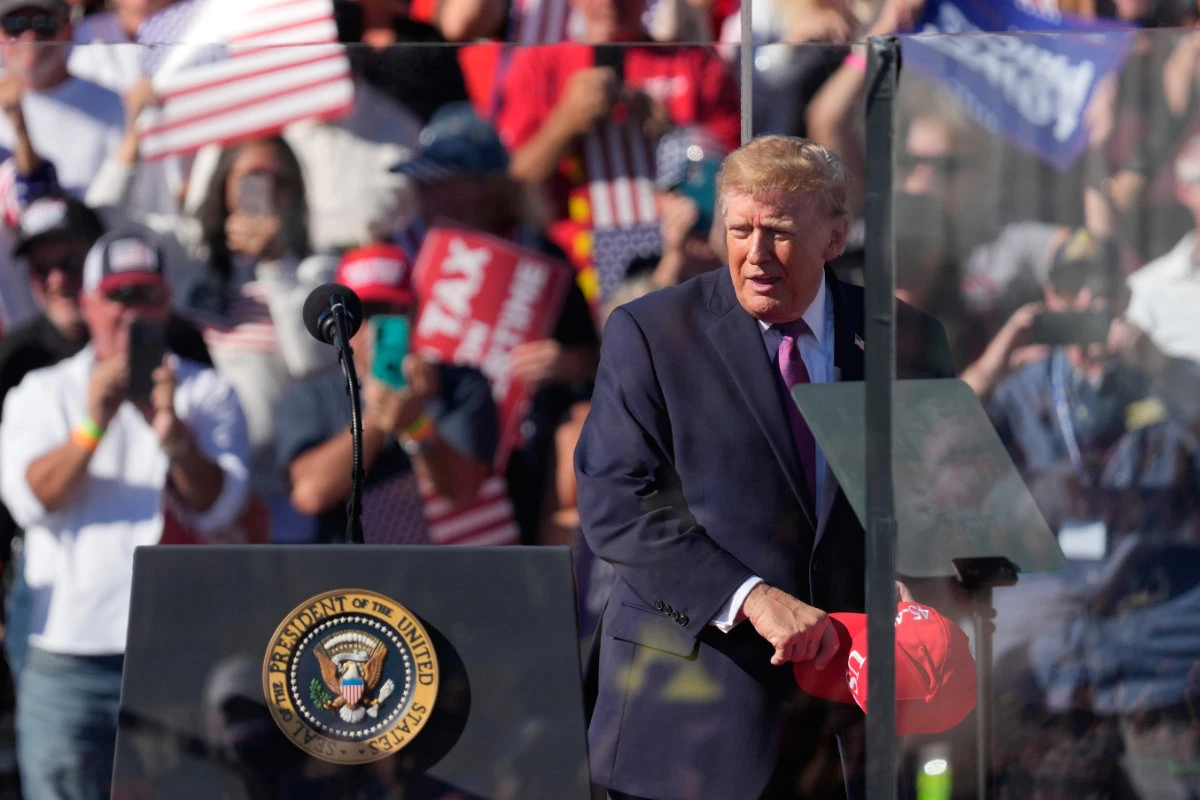
LONDON: Ahead of what is expected to be one of the most closely contested US midterm elections in recent history, Washington’s policy on the Middle East could have a significant bearing on the outcome as President Donald Trump’s Republicans fight to retain control of the Senate and House of Representatives.
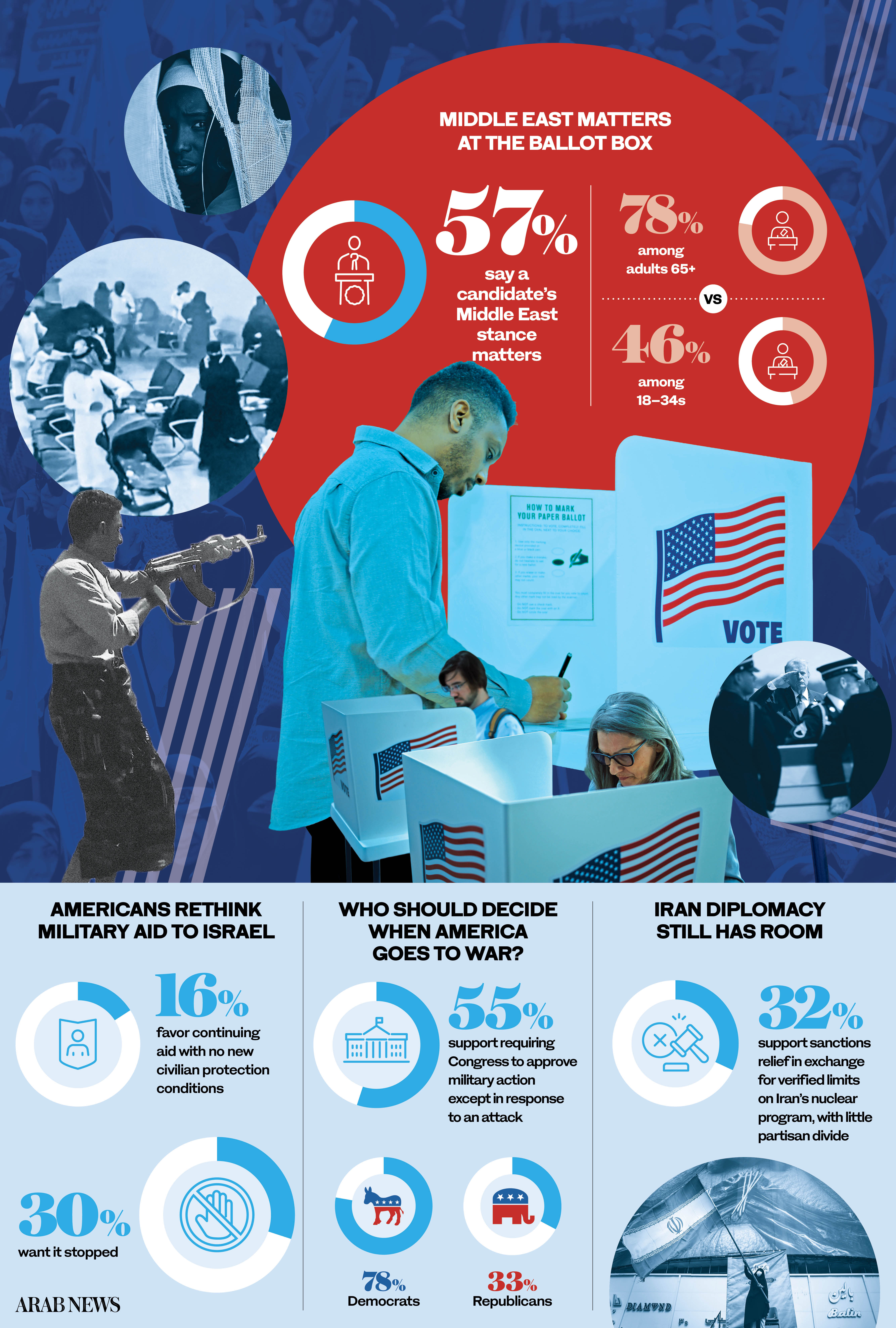
A recent survey by Asharq Bloomberg/Ipsos found that 57 percent of respondents considered a candidate’s position on US military involvement in the region an important factor in deciding their vote. The majorities were similar among Republicans (65 percent) and Democrats (68 percent), and the trend was even more pronounced among voters age 65 and older, at 78 percent.
This bipartisan alignment stands out in an otherwise deeply divided electorate. It also shows how events in the Middle East reverberate far beyond the region, and how decisions made in Washington rarely remain confined to domestic politics.
The divide is clearest when it comes to US military aid to Israel. In a year that has seen continuing protests against Israel’s wars in Gaza and Lebanon, only 16 percent of respondents said they supported continuing military aid in the absence of new conditions to protect civilians, and 30 percent wanted assistance to end altogether.
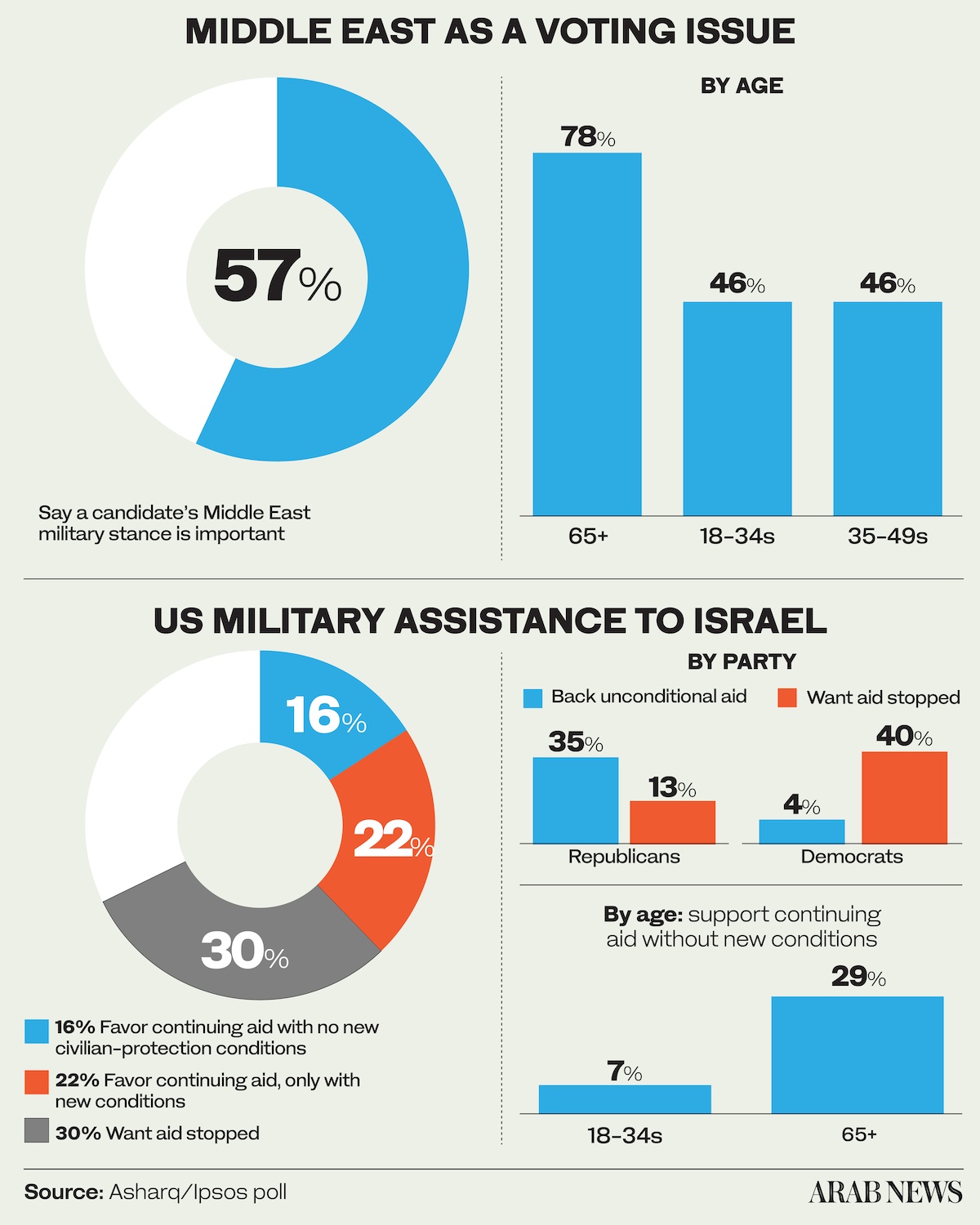
Looking more closely at the figures, only 4 percent of Democrats supported unconditional aid, and 40 percent wanted it to end. Among Republicans, who are generally more supportive of Israel, 27 percent favored new conditions and 13 percent opposed aid altogether.
Only 7 percent of 18-to-34-year-olds supported unconditional aid — an unsurprising result, perhaps, given the youth-led protests against Israel’s war in Gaza — compared with 19 percent of those age 65 and older. Among the older group, 29 percent wanted aid to end and 29 percent wanted it to be conditional.
By comparison, 57 percent of people age 65 and older expressed a favorable view of US military aid to Israel in an April 2024 Pew Research survey, conducted in the wake of the Oct. 7, 2023, Hamas-led attacks on Israel that triggered the war in Gaza.
The findings reflect a broader shift in the debate over Israel’s conduct in Gaza, and Washington’s long-standing support for the country.
Israel has been the largest cumulative recipient of US foreign assistance since the Second World War, receiving more than $300 billion, according to the Congressional Research Service. But after three years of war, that support is under ever-greater scrutiny, particularly among Democrats and younger voters.
The conflict has widened as Israel extended its military operations into Lebanon and then Iran. In late February this year, a limited joint Israeli-US operation in Iran drew Washington directly into the fighting, which swiftly escalated into a regional crisis with global consequences.
The fallout has affected Americans directly through spiraling fuel costs, cutting across the domestic concerns that usually dominate midterm elections.
The polls in November will decide control of Congress and, with it, the ability of the administration to pass legislation. It will also shape the final two years of Trump’s presidency and his ability to manage the Iran crisis.
Since Trump bypassed Congress to launch Operation Epic Fury in February, voters appear to have grown more uneasy about how US military action is authorized.
About 55 percent of those surveyed supported rules that require a president to obtain congressional approval before taking military action against another country, except in response to an attack against the US or its armed forces.
While the figure rose to 78 percent among Democrats, the 33 percent of Republicans who voiced support was perhaps more telling, in a party that has largely rallied behind the president since he took office; 36 percent of Republicans said they opposed such rules.
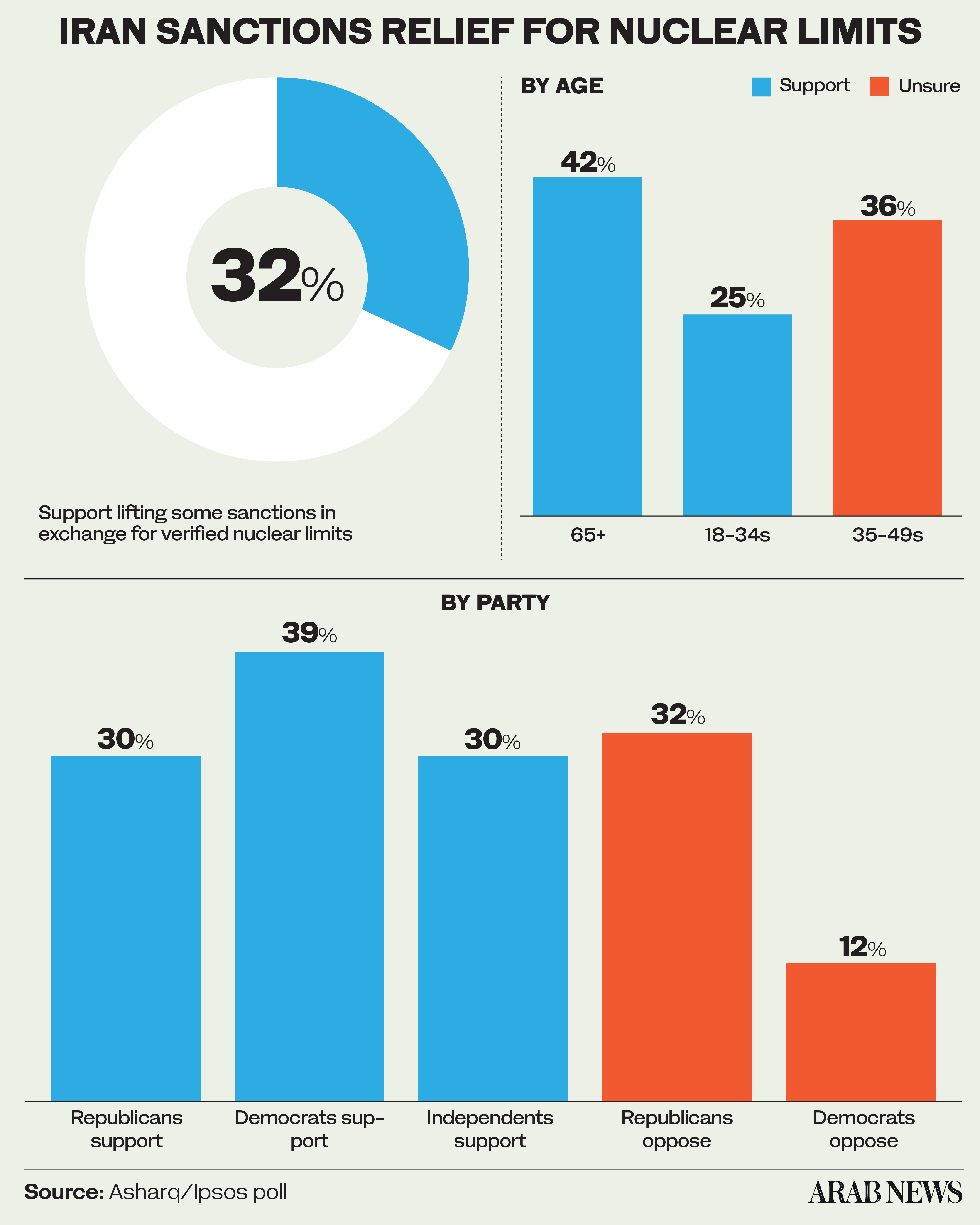
American policy on Iran is also under scrutiny. Trump withdrew the US from the Obama-era Iran nuclear deal, officially known as the Joint Comprehensive Plan of Action, in 2018, during his first term, and no replacement agreement has been reached. About 32 percent of respondents supported sanctions relief for Iran in exchange for internationally verifiable nuclear limits, while 29 percent were unsure.
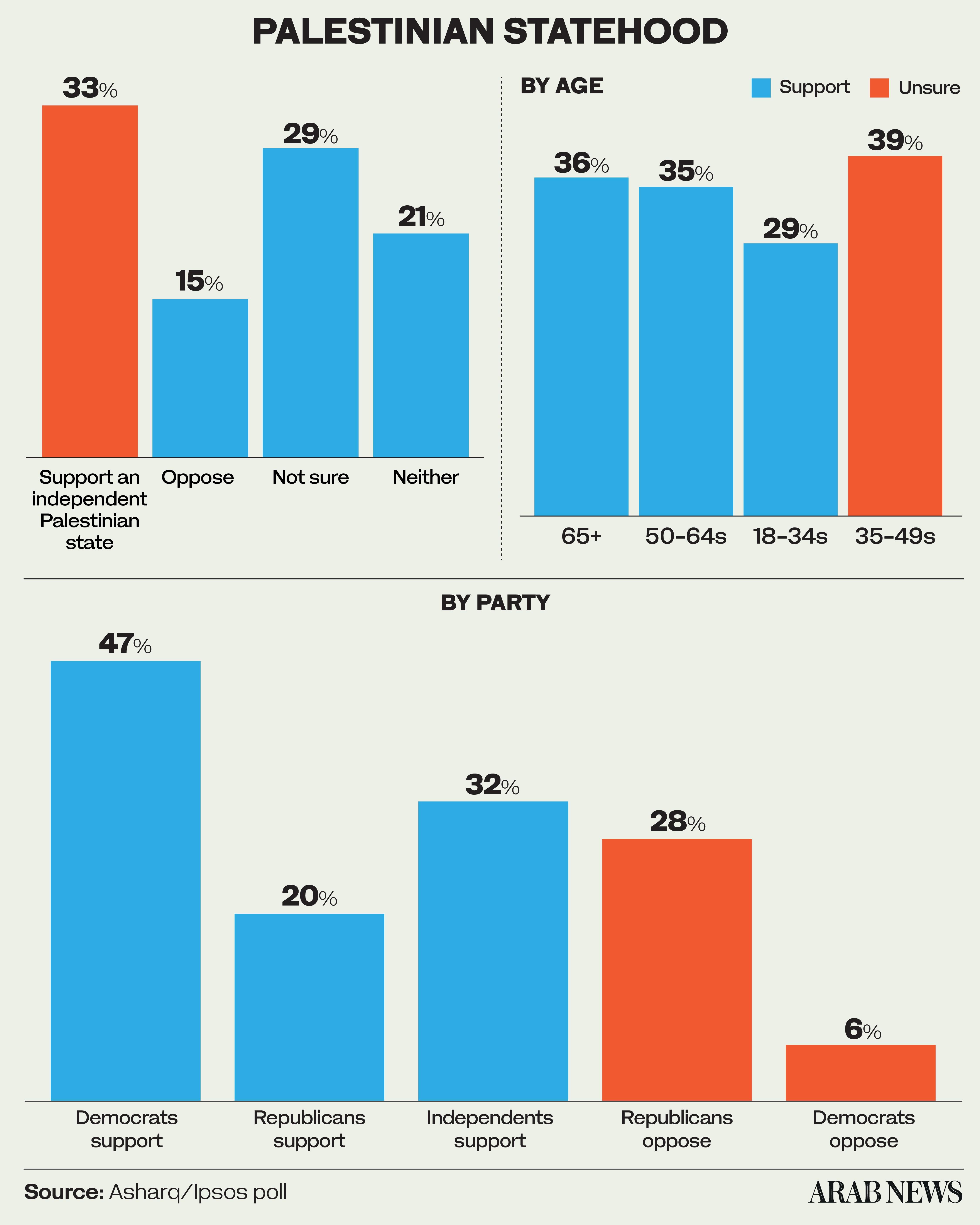
The war in Gaza has also elevated the issue of Palestinian statehood in the US political conversation. Overall, 33 percent of those surveyed said they supported an independent Palestinian state alongside Israel as part of a negotiated peace agreement, while 14 percent opposed it. Nearly half had no settled view on the issue. Support rose to 47 percent among Democrats, compared with 20 percent among Republicans.
There has been a recent sharp escalation in settler violence in the occupied West Bank during the annual olive harvest season; the UN has recorded more than 200 attacks since Sept. 1, a figure that already exceeds the 185 documented during the entire 2025 harvest season.
International concern intensified when settlers assaulted Washington Post photojournalist Heidi Levine on Oct. 16, and attacked a delegation that included European diplomats near Taybeh the following day.
The violence has coincided with renewed settlement-expansion plans, including tenders for 1,234 homes in the E1 area east of Jerusalem. The UN has warned that the development would divide the West Bank and undermine the Palestinian quest for statehood.
The survey also suggested a more cautious public mood over possible US military commitments in the region. Secretary of State Marco Rubio recently reiterated that Washington was ready to honor its security commitments to Saudi Arabia amid renewed fighting between Yemeni government forces and the Iran-aligned Houthis, as well as direct attacks on Riyadh.
However, the survey found that 53 percent of surveyed adults had no settled view on a formal US pledge to use military force if Saudi Arabia was attacked by another country, with 30 percent unsure and 23 percent neutral on the issue.
Support for a defense commitment stood at 19 percent overall, but varied significantly along political lines; Republicans were more likely to support the pledge, at 34 percent, compared with just 10 percent of Democrats and 14 percent of independents.
Generational differences were also pronounced. Support rose to 32 percent among adults ages 65 and older but dropped to 11 percent among 18-to-34-year-olds, and 13 percent among those between the ages of 35 and 49.
The poll also explored views on issues with a more direct effect on American households. On Monday, Trump announced an $8 billion aid package to help farmers pay for diesel during the harvest season, seeking to win over voters angry about grocery prices that remain at record highs because of the Iran war and are adding to frustration over the cost of living.
On energy security, 20 percent of respondents said they favored an expansion of US oil production, while a similar proportion supported a reduction in oil use. The partisan divide was pronounced, with 48 percent of Republicans favoring increased production, while 36 percent of Democrats preferred to cut consumption.
This split underscored a broader ideological conflict within American politics over how to address vulnerability to global energy shocks.
Republicans lean heavily toward supply-side solutions, prioritizing domestic production as the primary driver of energy independence and economic stability. Democrats favor a demand-side approach centered on energy efficiency and alternative sources.
Overall, the poll tells a familiar story of a divided America, split on solutions but often united in uncertainty. Voters across party lines showed relatively little disagreement on a few key issues, including the importance of issues such as Middle East military involvement and sanctions relief for Iran.
On others, including congressional approval of military action, energy security and Israel, they remained far apart.
With control of Congress at stake next month and polarization set to shape another election, the results of the survey suggest that foreign policy will not replace domestic concerns as the central issue of the midterms.
But in a close contest, dissatisfaction over Gaza, doubts about military interventions, and concern over the economic consequences of regional conflict could influence turnout and support among key voter groups.
Whether that produces a divided government, and what that would mean for the Middle East, remains to be seen.