
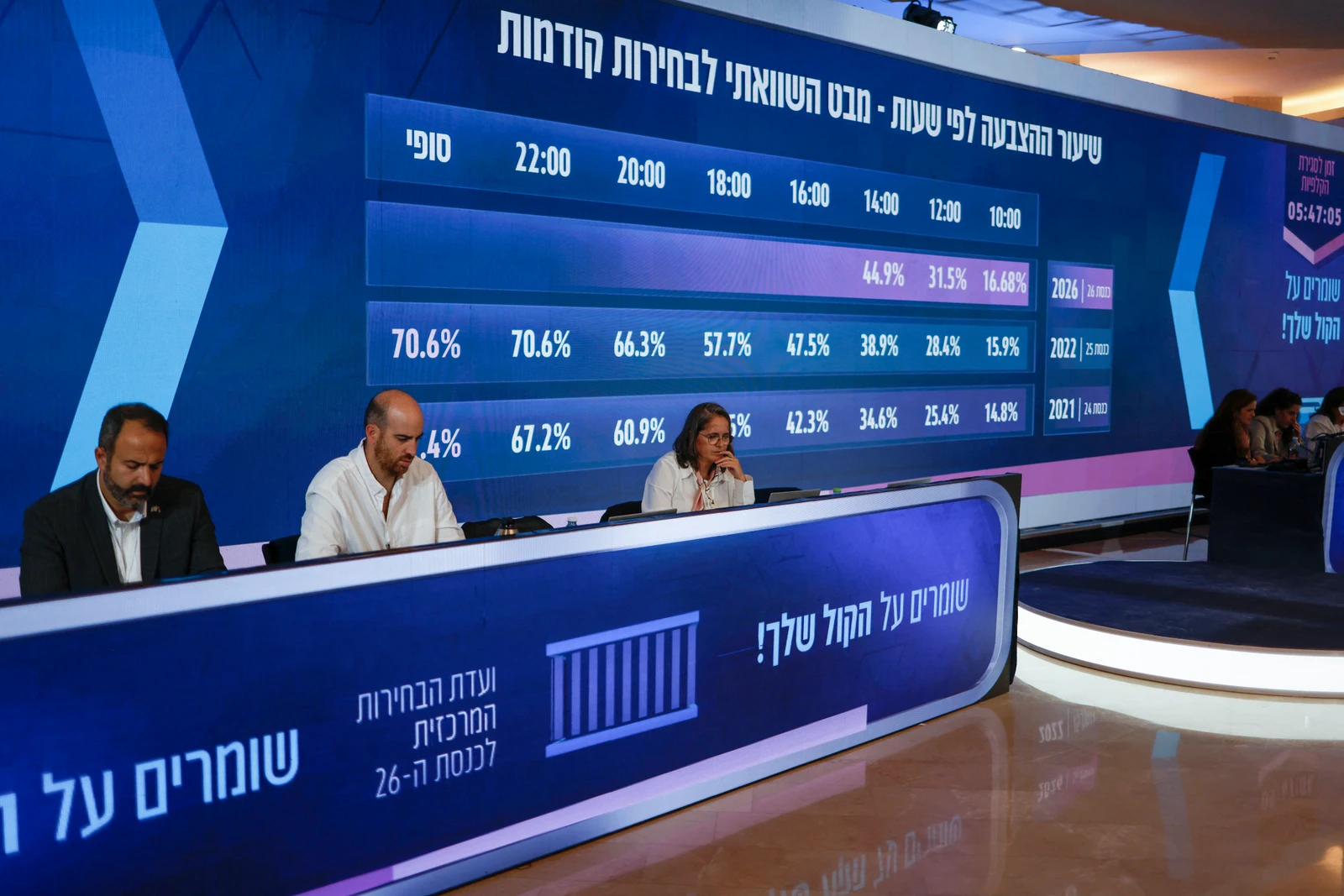

Much of the Israeli and international media hailed last week’s Israeli election in historic terms, as the most significant in the country’s history. The hyperbole was barely justified. It was like a dull score draw in front of a full stadium, with unwarranted high expectations leading to a tepid impasse.
But what happens next in the region and how this Israeli election might affect the dynamics of the next few weeks could justify the overblown descriptions.
The Israeli electoral draw leaves Netanyahu in office and in pole position. He will block any obvious pathway for a government that excludes him personally, including by challenging the legitimacy of the election, with unevidenced accusations of foreign interference already being rolled out. Time will tell whether his opponents have the courage to set aside their overt anti-Arab racism and work with the Palestinian parties, which secured a record 19 seats.
But how will Netanyahu behave as caretaker prime minister? He will not shift out of election mode. The best prospect for him to stay in office might be to hold out for a second election in early 2027. He will push his rivals into the most awkward corners possible.
Netanyahu will be hankering after resuming the war on Iran. His rivals will have to back him or risk a public backlash
Chris Doyle
The Netanyahu of the last three years has been a full-throttle hypernationalist aggressor. He will be hankering after resuming the US-Israeli war on Iran. His rivals will have to back him or risk a public backlash. The first Netanyahu offensive will be packed full of charm and directed toward 1600 Pennsylvania Avenue. He may ask President Donald Trump to press harder for a Netanyahu-led national unity government.
How such a charm offensive will be met might well depend on how this week’s midterms go for Trump. Be assured that Trump will not consider himself constrained, whatever the outcome. That he takes the US back to war is not inevitable but the gathering of US military assets in the Middle East theater will ensure his threats pack more punch.
The Israeli prime minister has other options. The other front to escalate will be the Palestinian one. Yet again, this will be designed to pressure his opponents to back him. He has threatened a clearout of areas in Hebron, much as Israeli forces did in the northern West Bank at Jenin and Tulkarem. Also on the menu is the approval of tenders for the E1 doomsday settlement. The first batch of tenders are scheduled to be approved from Nov. 19.
If this seems insufficiently expansive, what is left of Gaza awaits. On this front, he can claim that Hamas has had its chance to disarm and that Israel will have to “finish the job,” as his Defense Minister Israel Katz claimed in September. Israeli forces can retake the remaining 30 percent of the Strip. The most extreme move would be to try to force out large numbers of Palestinians.
The election has sharpened the focus on two features of Israeli politics that damage its reputation
Chris Doyle
Itamar Ben-Gvir will not be inactive, as he will be determined not to be ignored or bypassed. He has executions of Palestinian prisoners that he cannot wait to carry out. Stirring things up in Jerusalem is a further option.
As for the Iran front, Netanyahu will want war. A state of emergency inside Israel would suit his purposes. But war would be fraught with risks to Israeli security and its economy. A hit on Ben Gurion Airport would shut down the tourism industry. Israel’s desalination plants could also be targeted, as could the Dimona nuclear reactor.
The Iran front could also become a multifront war. Would the Houthis and Hezbollah lay off? The Israeli capacity to take out missiles and drones would be tested to the utmost, along with the extent of its munition stocks.
If Gadi Eisenkot were to shape a new coalition with the support of the Palestinian parties, the more aggressive options may get taken off the table. Pushing forward with E1 and a full-scale onslaught on Gaza could crash the coalition before it got into first gear. The two Palestinian parties would have significant influence for as long as the coalition needs them to jettison Netanyahu from the Israeli political scene. This includes setting up an Oct. 7 commission and reversing Netanyahu’s efforts to restrict the independence of the judiciary.
The election has sharpened the focus on two features of Israeli politics that damage its reputation. The first is the anti-Arab racism that is so widespread it is electorally beneficial to try to ban Palestinian parties and block their candidates. Even though most would love to see the back of Netanyahu, they do not want to do this with Palestinian backing.
Secondly, Israeli politics has shown itself to be more extreme and aggressive than ever. Bombing Iran again achieved near-consensus. Where was the debate about the wisdom of such an option? Likewise, Israeli actions in Lebanon, Syria and Yemen barely registered. The ethnic cleansing of Palestinians was given an electoral mandate.
For Israelis who crave normalization with neighbors such as Saudi Arabia, these two trends are hardly endearing. The bottom line is that Israeli voters have overwhelmingly voted to reject any rapprochement with the peoples of the region in favor of full-throttle aggression.
Chris Doyle is director of the Council for Arab-British Understanding in London. X: @Doylech


