
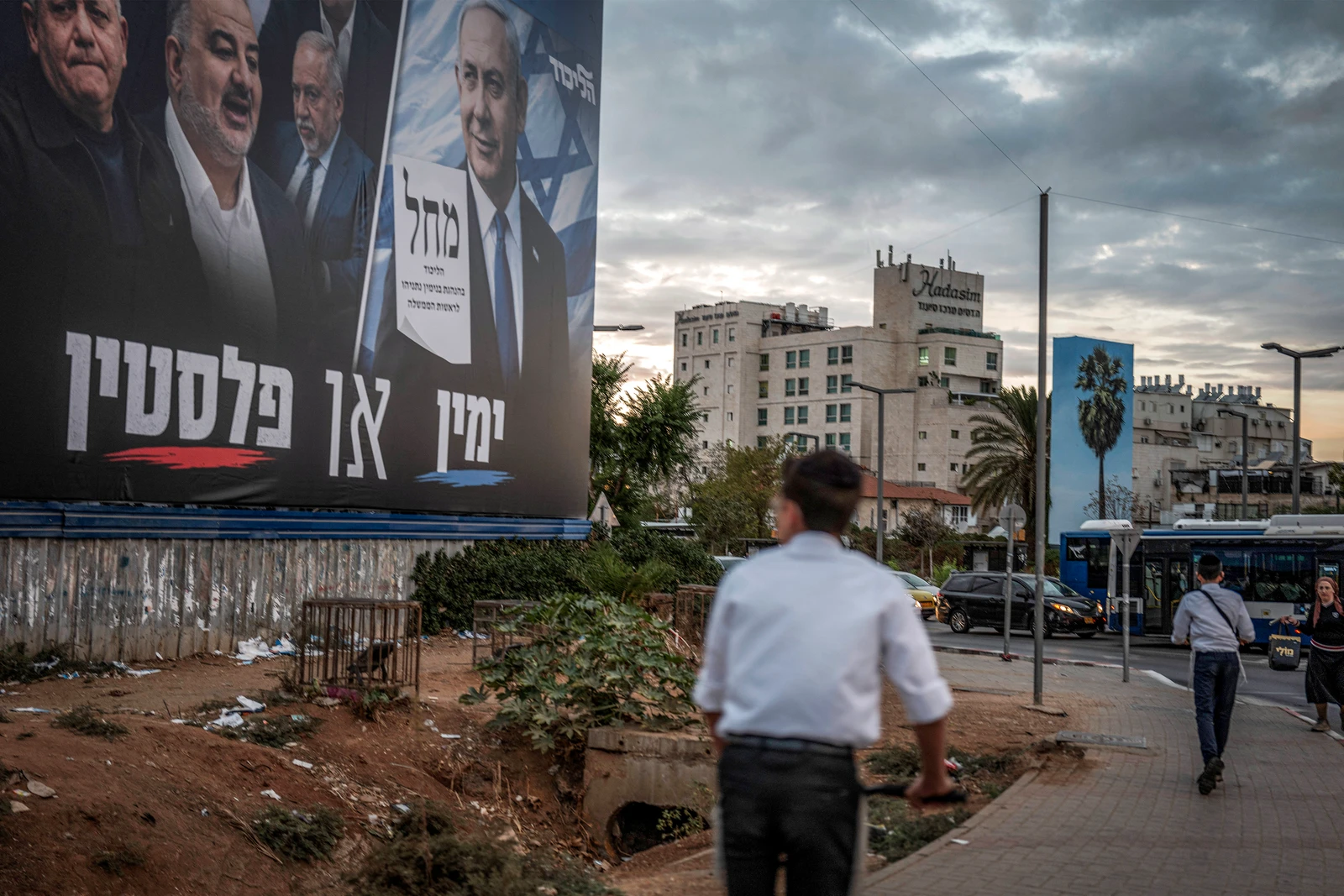

The results of Israel’s Oct. 27 election have been welcomed by Palestinian communities in Israel and worldwide.
Neither the right-wing bloc of Israeli Prime Minister Benjamin Netanyahu nor that of his rival, former military chief Gadi Eisenkot, secured the 61 seats required to form a government. This made the 19 seats won by Palestinian parties all the more consequential.
In a political system structured to marginalize its Palestinian minority, the electoral achievement of the Joint List and Ra’am cannot be overstated. Through their relative unity and an extraordinary convergence of political circumstances, Palestinian voters have seemingly managed to beat the system.
This achievement came despite fearmongering and outright racist rhetoric by the mainstream Jewish political parties and their leaders, including Eisenkot.
Netanyahu built much of his campaign on the specter of a Palestinian political takeover. On election day, he warned: “If we don’t wake up now, we’ll find ourselves with a government of Mansour Abbas and Ahmad Tibi.”
While presenting itself as democratic, Israel has waged political, legal and constitutional wars against its Palestinian citizens
Dr. Ramzy Baroud
Far-right National Security Minister Itamar Ben-Gvir employed similar rhetoric. Alarmed by Palestinian turnout, he declared: “If you want this country to stay Jewish and Zionist … go out and vote.” He also warned his supporters: “Don’t let them win.”
Even Eisenkot, often portrayed in Western media as a more amiable and less hawkish alternative to Netanyahu, rejected the prospect of governing with the Palestinian parties, declaring: “I do not see an Arab party that accepts my principles.”
Whether the electoral deadlock forces him to reconsider that position is another matter. The point is that Eisenkot and his potential allies, including Naftali Bennett and Yisrael Beiteinu leader Avigdor Lieberman, have rejected Palestinian participation in any governing coalition.
Imagine this happening in a true democracy: an entire political community excluded from government because its members are Black, Irish or Christian, for example.
This is the crux of Israel’s democracy problem. While presenting itself as democratic, Israel has waged political, legal and constitutional wars against its Palestinian citizens, treating their very identity as a threat to the Jewish character of the state.
Historically, this has been the central point of contention among Palestinian communities in Israel: Why should Arabs participate in elections that validate a system constructed, from its foundation, to entrench Jewish supremacy and persecute its Palestinian minority?
History occasionally produces moments so dangerous that even morally defensible positions must be reconsidered
Dr. Ramzy Baroud
Consider the Knesset itself. Section 7A of its Basic Law allows electoral lists and candidates to be disqualified for rejecting Israel’s existence as a Jewish and democratic state. Imagine Black American politicians being required to recognize the US as a white nation before being permitted to contest elections.
In 2018, Israel went further, passing the Nation-State Basic Law, which declares that the right to national self-determination in Israel is “unique to the Jewish people.” It is therefore hardly surprising that some Palestinian political movements have refused to participate in what they regard as a political charade, choosing instead to defend their communities’ rights outside of a fundamentally rigged parliamentary system.
One example is Abnaa Al-Balad, which has long advocated boycotting Knesset elections rather than granting legitimacy to the Israeli political order.
This debate resembles the historical disagreement between revolutionary abstentionism, which rejects participation in institutions deemed illegitimate, and socialist parliamentary participation, which argues that refusing parliamentary engagement should not become an absolute principle. Israel’s latest election has given this debate renewed urgency.
To be clear, although some Arab parties have roots in leftist traditions, none can simply be described as revolutionary.
Ra’am, led by Mansour Abbas, participated in the Zionist coalition government formed by Bennett and Yair Lapid in June 2021. Abbas effectively sidelined broader Palestinian national aspirations in favor of municipal budgets, socioeconomic equality and combating crime within Palestinian communities in Israel. Ra’am last week won eight seats and Abbas has made clear his willingness to pursue the same strategy.
The Joint List, meanwhile, secured 11 seats. Its priorities include removing Netanyahu, defending Palestinian national rights and advancing social justice for the Palestinian citizens of Israel.
Now, more than ever, Palestinians need unity. All are facing extraordinary threats: the ongoing genocide in Gaza, accelerating annexation and ethnic cleansing in the West Bank, and further suppression of Palestinian communities inside Israel.
By uniting around a political program capable of defeating Netanyahu’s far-right agenda and setting aside their factional interests, Arab politicians could achieve something their previous parliamentary efforts failed to accomplish: they could force Israel to change direction, slow its machinery of death and remove Netanyahu, who is wanted on war crimes charges, from power.
While one may insist, on principle, that participating in a corrupt political system validates that very system, history occasionally produces moments so dangerous that even such morally defensible positions must be reconsidered, however temporarily.
The choice now is not between purity and betrayal but between paralysis, allowing Netanyahu’s wars to continue unchecked, and strategic disruption.
Certain distinctions, however, must remain absolutely clear. Replacing Netanyahu is not liberation. Eisenkot is no peacemaker — he is a committed Zionist whose military record and political positions offer Palestinians little reason to expect justice. A new Israeli government will not erase the crimes of the state or fundamentally dismantle its apartheid system.
What such a change might offer, however, is a disruption of the alliance through which Netanyahu, Ben-Gvir and Bezalel Smotrich have pursued their agenda of genocide, ethnic cleansing and annexation, potentially slowing Israel’s capacity to inflict violence on the current scale.
Real change, on the other hand, can only be achieved through genuine Palestinian unity and resistance on all fronts, sustained global solidarity, legal accountability and meaningful political action.
Dr. Ramzy Baroud is a journalist, author and the editor of The Palestine Chronicle. His latest book, “Before the Flood,” was published by Seven Stories Press. His website is ramzybaroud.net. X: @RamzyBaroud


