
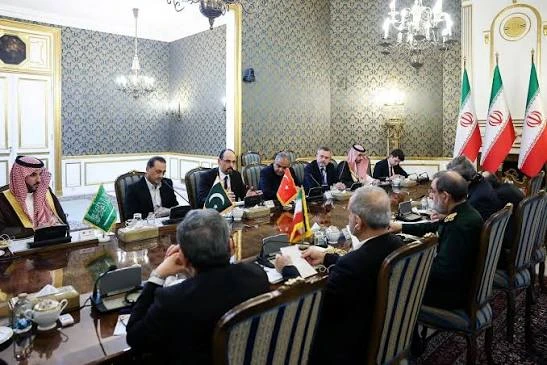

When Saudi Defense Minister Prince Khalid bin Salman, Pakistani army chief Asim Munir and Turkish intelligence chief Ibrahim Kalin last week sat down in Tehran, across the table were Iran’s most senior officials: President Masoud Pezeshkian, Supreme National Security Council Secretary Mohsen Rezaei and Foreign Minister Abbas Araghchi.
The trip was meant to support the Qatari-Pakistani mediation between Washington and Tehran. The stakes were rising. Houthi attacks on Saudi Arabia and disruption in the Strait of Hormuz had put regional security and the global economy under strain, while strikes on civilian airports had killed and wounded people of several nationalities.
Sources told me the delegation brought a clear message. The members of the Makkah Joint Defense Agreement wanted to stop a return to war, but not at the expense of their security interests or their independence in strategic decisions. They would rather mediation succeed than see fighting resume.
The talks also looked at whether a durable US-Iranian settlement was possible — one that would serve everyone, the Arab Gulf states included. The warning behind that was plain. If threats against Iran’s neighbors continue, war resumes between Iran, the US and Israel, and the Revolutionary Guards hit Gulf cities and targets, Riyadh and its allies would defend themselves through the legitimate military means international law allows. Tehran should be under no illusion: such a step would push its neighbors further away than ever.
The talks looked at whether a durable US-Iranian settlement was possible — one that would serve everyone
Hassan Al-Mustafa
Rayed Krimly, the Saudi Foreign Ministry’s deputy minister for public diplomacy, said the mission aimed at “de-escalation between the parties to the current crisis” and “encouraging dialogue and diplomatic solutions” in support of the Qatari and Pakistani mediators. The ministry added that it hoped the parties would “engage positively and pragmatically with the outcomes of this visit.”
Taken together, these statements show Riyadh pushing diplomacy toward tangible results and greater Iranian flexibility. That would give the mediators proposals they could take to US President Donald Trump. At the least, they could discuss those proposals with him and urge him to accept them, as long as they genuinely serve everyone: averting war, reining in Iran’s destabilizing activity and denying Israel a pretext for another military operation.
The delegation’s makeup was deliberate. Saudi Arabia, Turkiye and Pakistan all have political and defense ties with Washington and their own lines to Tehran. That lets them pair deterrence, should Iran resume attacks, with de-escalation, should it engage. Sending senior defense and security figures rather than diplomats alone also matters. It brings to the table issues handled by military and intelligence services: maritime security, cross-border threats and armed militias.
No closing statement was issued but the sides agreed to keep talking about cooperation, peace and regional security.
Reuters quoted a Pakistani official as saying the discussions touched on a regional nonaggression framework, with the Makkah Agreement states and Qatar as possible guarantors. None of this has yet become a public commitment. There are no agreed mechanisms for carrying it out or for handling breaches, and years of miscalculation and mistrust will have to be worked through step by step.
If Tehran treats today’s diplomatic opening as proof of its own strength, or of its neighbors’ fear, it risks overplaying its hand
Hassan Al-Mustafa
Vali Nasr, the Iranian-American scholar, argued on X that the meeting handed Iran a propaganda win, which Tehran would use to build a regional security order with itself at the center. That reading mistakes the photo opportunity for the substance. The real question is what the three countries actually said behind closed doors — and their messages were serious and direct. Saudi Arabia, Turkiye and Pakistan went to Tehran to head off the threat of a new war and to press Iran to respect its neighbors and international law. Nothing from the visit suggests they accepted Iran’s vision of regional security or rethought their strategic partnerships with Washington.
The record explains why. For decades, Iran’s Revolutionary Guards have threatened Gulf security, arming local groups with explosives and intelligence. Until that behavior changes, there can be no real security partnership across the Gulf.
If Tehran treats today’s diplomatic opening as proof of its own strength, or of its neighbors’ fear, it risks overplaying its hand and wasting a genuine chance at lasting peace.
History offers a warning. On Jan. 9, 1991, US Secretary of State James Baker met Iraqi Foreign Minister Tariq Aziz in Geneva. The talks failed to persuade Baghdad to comply with UN Security Council resolutions and leave Kuwait, and war broke out days later.
The two crises are different but the lesson holds: misreading a diplomatic opening is dangerous and so is assuming the other side will keep making offers indefinitely and for nothing.
The Qatari-Pakistani mediation has to work on two linked tracks. One is between the US and Iran: the nuclear program, sanctions and the naval blockade. The other is regional: shipping through the straits, respect for sovereignty and attacks by Iran-backed militias.
A practical start would be gradual steps taken by both sides simultaneously. Iran would stop attacks on civilian and economic sites in the Gulf, guarantee safe passage for ships and tankers through the straits and open talks on its nuclear file, including the fate of its highly enriched uranium. In return, it would get a conditional, phased easing of economic and financial restrictions and access to part of its frozen funds for humanitarian, medical and food needs. It would also be allowed to export oil and trade by sea under monitoring, with a clear mechanism in place.
The goal should be a full plan of action that leads to a solid, lasting agreement, not another temporary understanding or fragile truce.
Hassan Al-Mustafa is a Saudi writer and researcher interested in Islamic movements, the development of religious discourse, and relations between Gulf Cooperation Council states and Iran. X: @Halmustafa


