

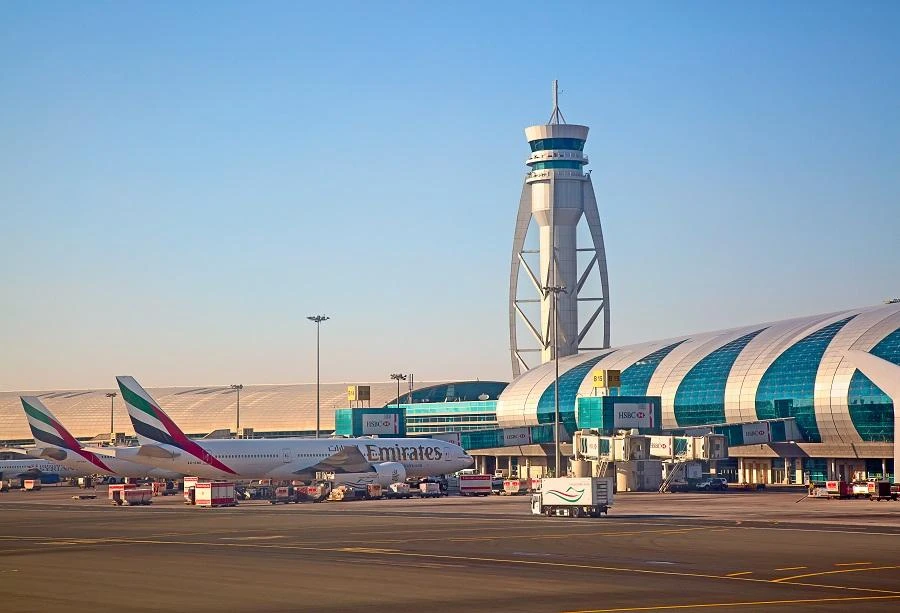
- Passenger traffic at Dubai International Airport (DXB) fell 28.1% year-on-year in the first nine months of 2026, with a 22.1% decline in the third quarter.
- DXB welcomed 50.4 million passengers between January and September 2026, including 18.8 million in the third quarter, with August being the busiest month at 6.6 million passengers.
- The decline in passenger traffic was influenced by the regional conflict starting Feb. 28, leading to airspace closures in the Middle East.
RIYADH: Passenger traffic through Dubai International Airport fell 28.1 percent year on year in the first nine months of 2026, while third-quarter volumes declined 22.1 percent, as earlier disruptions weighed on travel.
Dubai International, also known as DXB, welcomed 50.4 million passengers between January and September, including 18.8 million in the third quarter.
August was the busiest month of the quarter, recording 6.6 million passengers, according to a statement.
Regional conflict disrupts air travel as Dubai traffic recovers
The decline followed the regional conflict that began on Feb. 28, which disrupted air travel and led to temporary airspace closures across the Middle East.
Although the skies reopened following the April 8 ceasefire, the International Civil Aviation Organization said in an April report that air traffic had yet to return to pre-conflict levels.
Passenger numbers had begun to recover in the second quarter, rising from 3.5 million in April to 4.5 million in May and 5 million in June.
DXB welcomed 31.5 million guests in the first half of 2026, although the figure remained 31.3 percent below the same period a year earlier.
“We expect to welcome more than 70 million guests this year. As more airlines return to Dubai and our network strengthens, we are focused on continuing to accommodate future growth while making journeys simpler and more seamless,” Paul Griffiths, CEO of Dubai Airports, said.
Direct and connecting passenger traffic remained broadly balanced during the year, underscoring the airport’s role as both a gateway to Dubai and a global transit hub.
In September, passengers travelling directly to and from Dubai accounted for 49 percent of total traffic, while connecting passengers represented 51 percent.
The balance typically shifts seasonally, with direct traffic increasing during winter as Dubai’s tourism and events calendar attracts more international visitors.
Global connectivity, key markets
DXB is served by 57 airlines connecting Dubai to 235 airport destinations across 101 countries.
British Airways resumed flights earlier in November, joining carriers including Royal Air Maroc, SunExpress and Cebu Pacific, while other airlines are expected to restart services in the coming weeks.
India was the airport’s largest country market in the third quarter, accounting for 2.6 million passengers, followed by Saudi Arabia with 1.4 million and the UK with 1.3 million.
Pakistan contributed 800,000 passengers, while the US and Germany recorded 640,000 and 480,000, respectively.
London was the leading city destination, with 784,000 passengers, followed by Mumbai with 528,000, New Delhi with 525,000, Riyadh with 500,000 and Jeddah with 490,000.
Traffic also increased across several leisure destinations during the quarter, with Milan recording the strongest growth at 20 percent.
Phuket followed with a 17 percent increase, while Cape Town, Barcelona and Denpasar rose 14 percent, 13 percent and 11 percent, respectively.

