- 8 straw polls fail to produce consensus candidate
- 5 veto powers hold key as Antonio Guterres prepares to leave office
NEW YORK: In less than seven weeks Antonio Guterres will leave the UN’s top job after 10 years. The Security Council, which must choose his successor, has yet to agree on a candidate and no one can say with certainty when it will.
Since July 30 the council’s 15 members have met eight times behind closed doors to assess the candidates. A clear front-runner has emerged but consensus remains elusive.
Daniel Forti, head of UN affairs at the nongovernmental organization International Crisis Group, said that the delay was unusual compared with recent contests but not by the standards of UN history.
“We have collectively gotten used to the recent precedent of the Security Council making quick decisions,” he told Arab News.
Ban Ki-moon and Guterres were both chosen in October. But earlier contests produced several instances of UN chiefs being selected only after bitter negotiations in mid-December, he said.
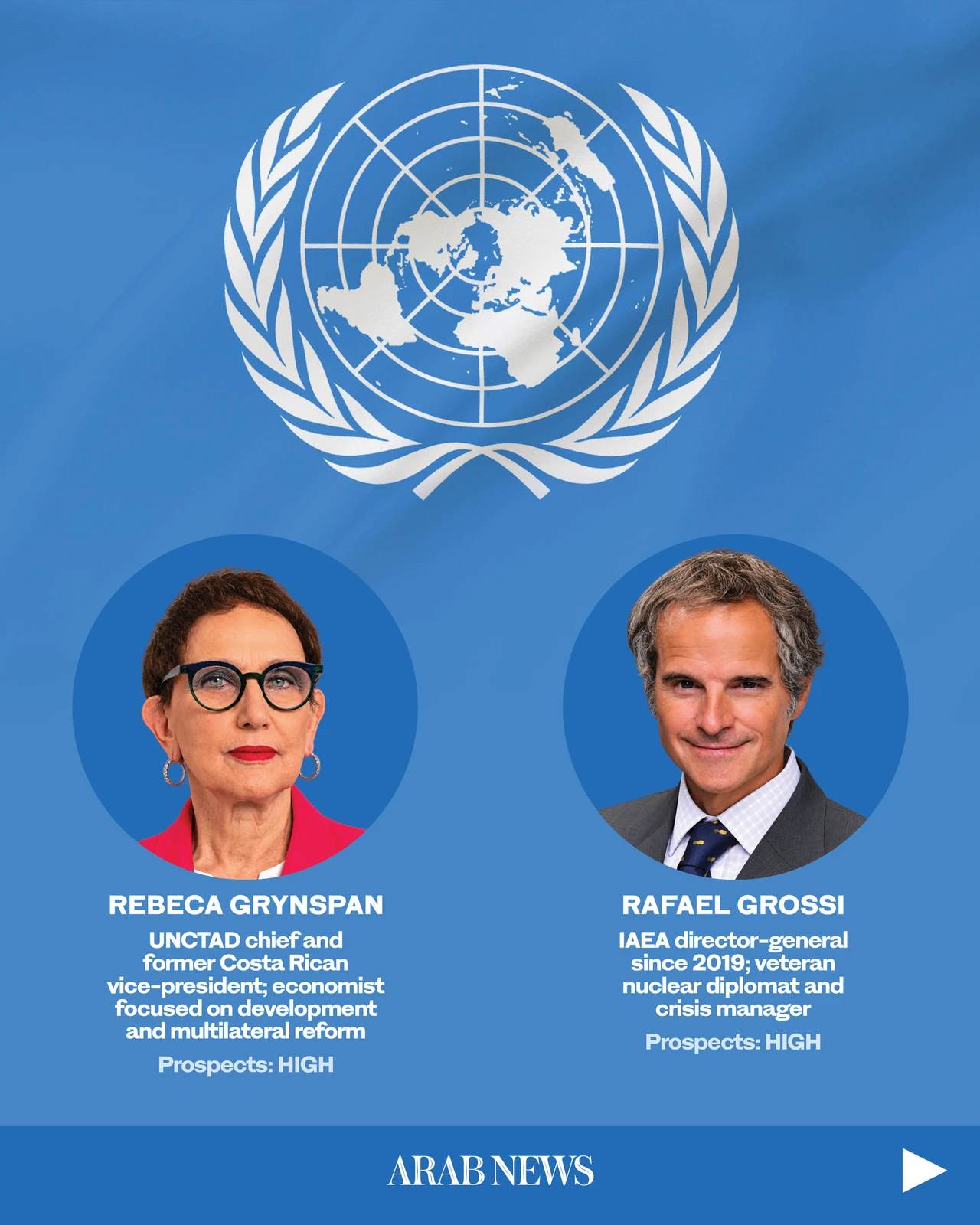
The latest poll, held on Nov. 5, produced the clearest result so far. Rebeca Grynspan of Costa Rica, who heads UN Trade and Development, received 12 “encourage” votes and three “discourage” votes.
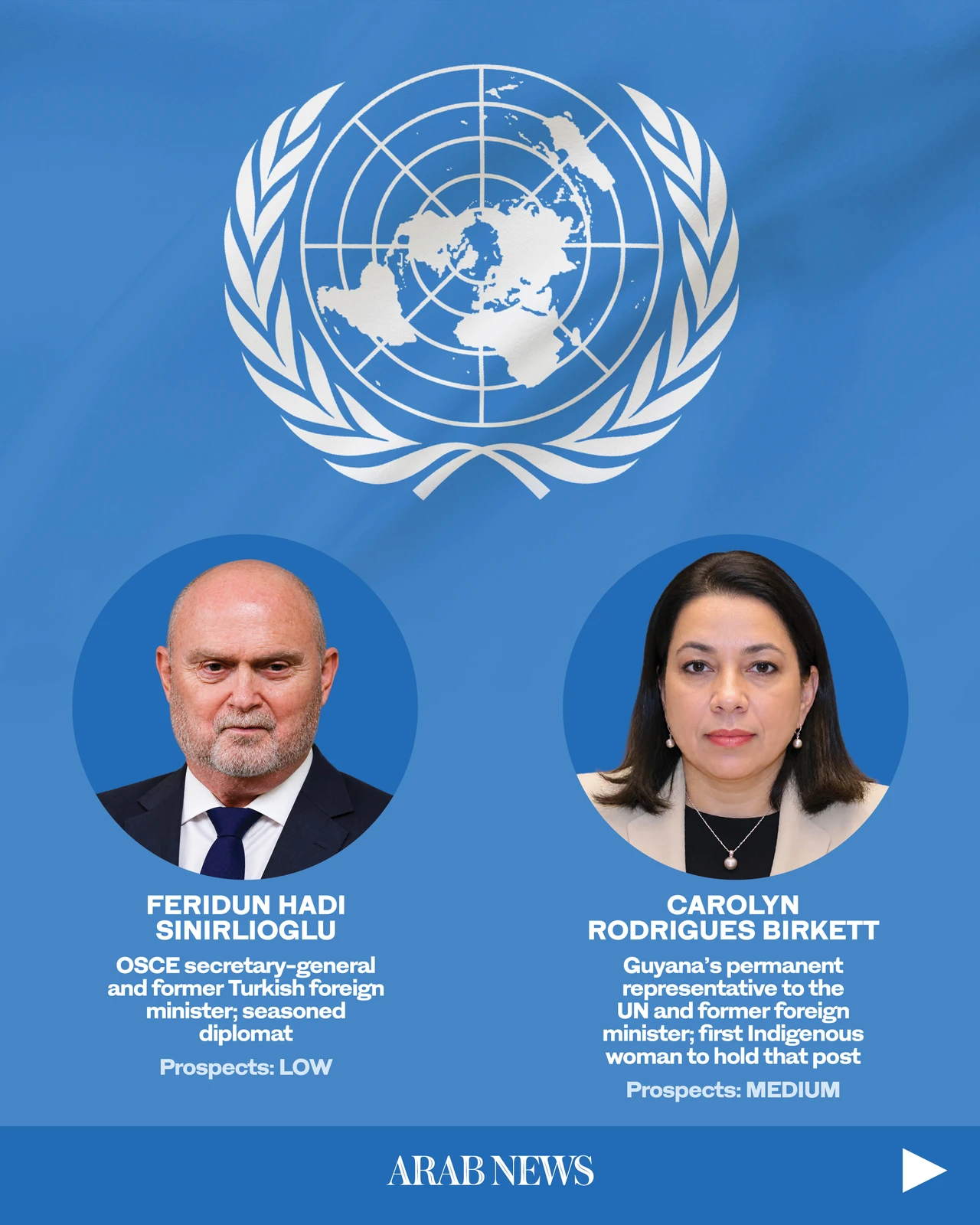
Argentina’s Rafael Grossi, director-general of the International Atomic Energy Agency, placed second with nine encourage votes. Guyana’s UN ambassador, Carolyn Rodrigues-Birkett, received eight.
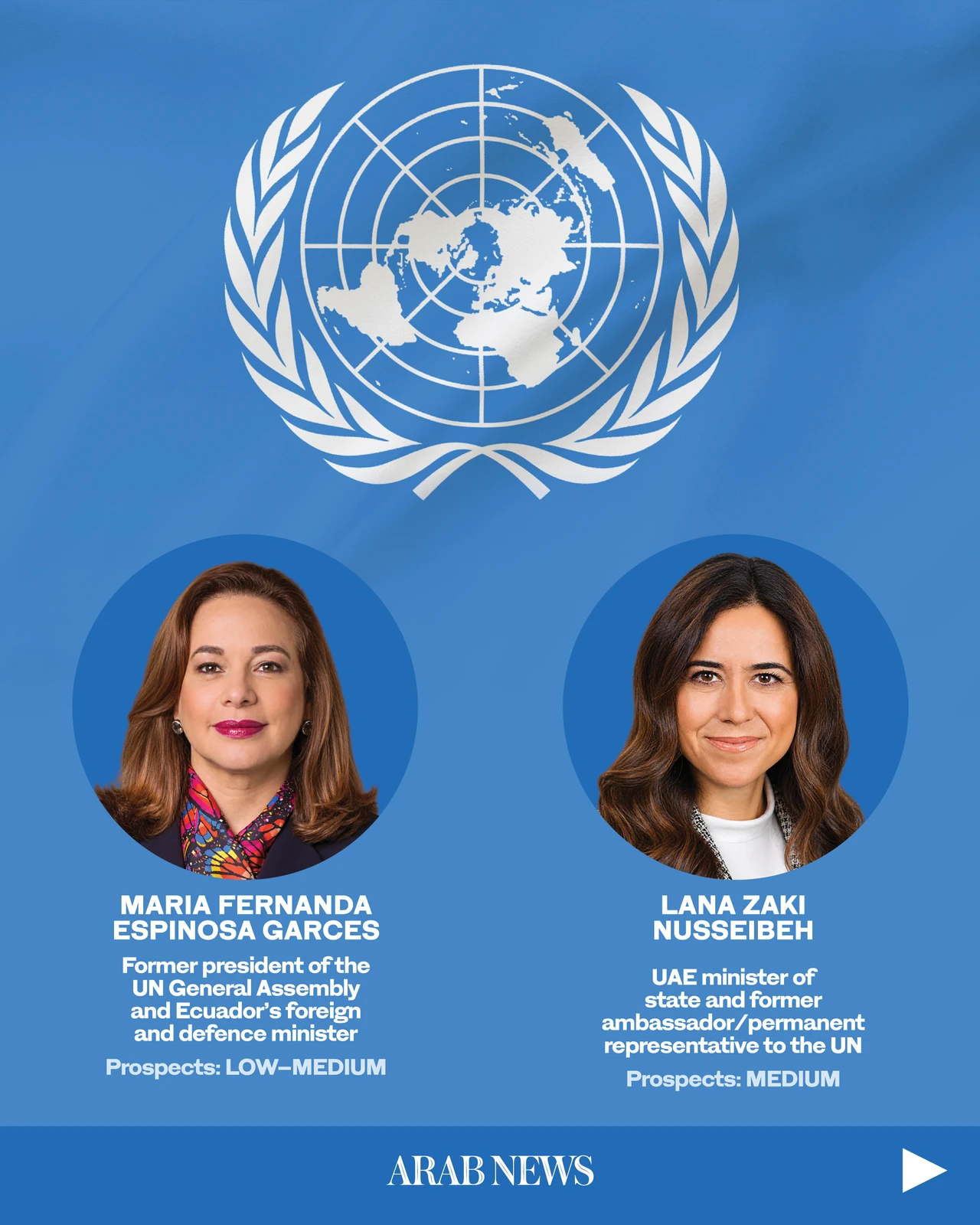
The UAE Minister of State Lana Nusseibeh was fourth with seven encourage votes, six discourage votes and two “no opinion” votes.
But coming first does not mean winning. The decisive question is whether any discourage votes came from the Security Council’s five permanent members: China, France, Russia, the UK and the US. Any one of them can block a candidate.
Under Article 97 of the UN Charter, the 193-member General Assembly appoints the secretary-general “upon the recommendation of the Security Council.” In practice, the council decides. A candidate needs at least nine of its 15 votes and no veto.
The council uses informal, secret straw polls to identify that candidate. Each member marks a ballot “encourage,” “discourage” or “no opinion.” Although the results are not announced officially, they usually leak within minutes.
The system was created in 1981 to break one of the worst deadlocks in UN history.
Austria’s Kurt Waldheim was seeking a third term, while Tanzania’s Salim Ahmed Salim had Africa’s backing. China repeatedly vetoed Waldheim and the US blocked Salim. The council voted 16 times over several weeks without reaching a decision.
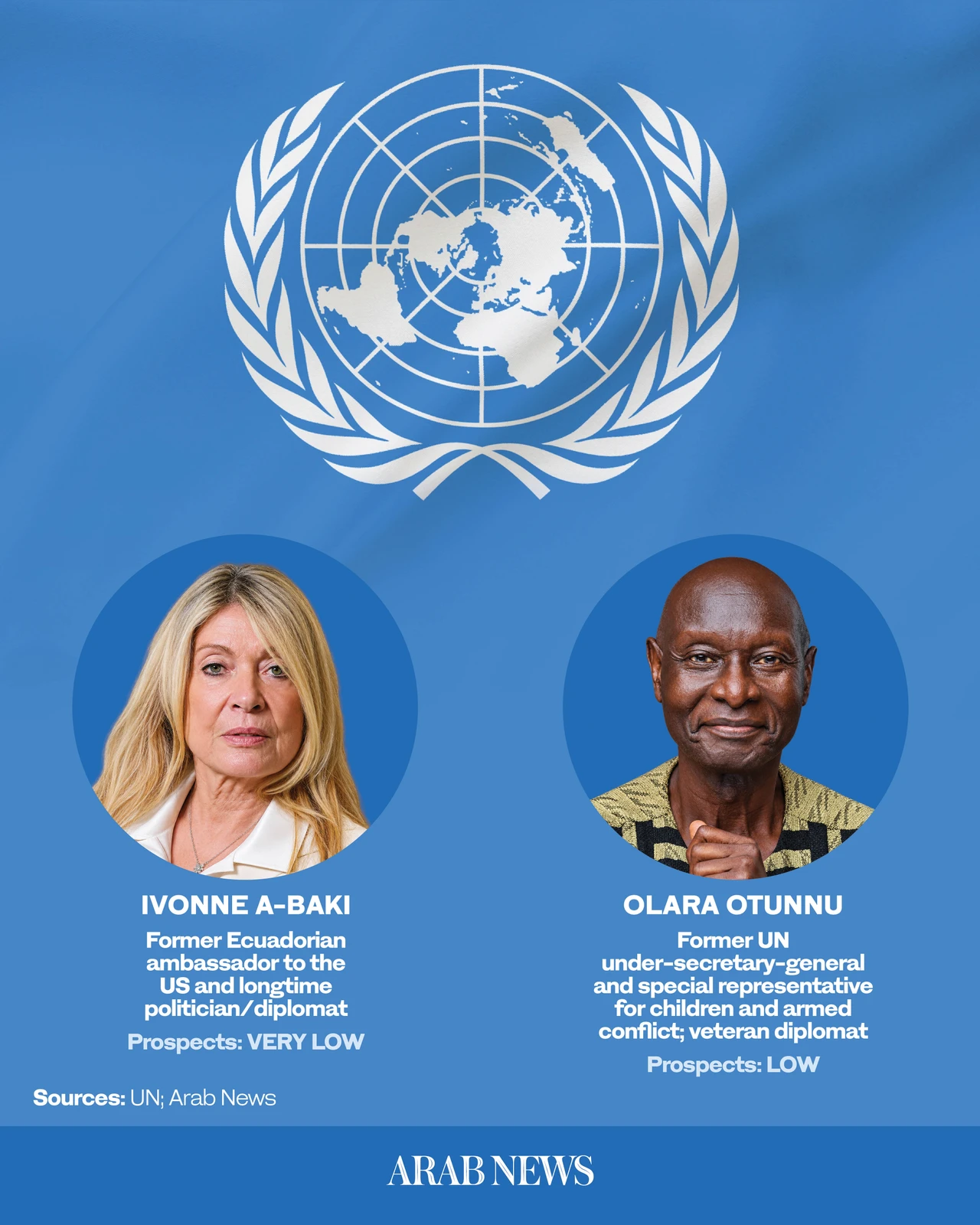
When Uganda’s ambassador, Olara Otunnu, assumed the council presidency in December, he persuaded both candidates to withdraw and devised a straw poll to identify someone none of the major powers would veto.
Within days the council chose Peru’s Javier Perez de Cuellar. The method became known as the “Otunnu formula.”
Forty-five years later, Otunnu is himself a candidate, being assessed through the system he created.
The process has evolved. In 1991 the council began using color-coded ballots — red for the five permanent members and white for the 10 elected members — to reveal whether candidates faced possible vetoes. The “no opinion” option was added later.
This year’s color-coded poll, held on Oct. 16, showed that no candidate had the backing of all five permanent members. Grynspan, Grossi and Rodrigues-Birkett each received two red discourage votes.
The permanent members are more divided than at any time in decades. Russia and the West remain at odds over the war in Ukraine, while Washington has made deep cuts to UN funding and wants a leader who will contain spending and concentrate on peace and security. Moscow is reported to favor a successor who is less critical of its war.
Despite pressure from other governments and civil society for a more transparent process, the permanent members “unfortunately hold all the cards” because of the veto, Forti said.
He cautioned against reading too much into a single ballot.
“We don’t have a sense yet of how significant the deadlock is between them, or whether there is even a deadlock at all, because we’re only going off of one colored ballot on one straw poll,” he said.
The five powers were “actively negotiating and exchanging their views right now,” he said.
Only further color-coded rounds will reveal whether their positions have shifted.
A red discourage vote does not necessarily end a candidacy.
“No red objection is necessarily a permanent objection,” Forti said, noting that previous candidates secured the council’s recommendation after initially facing opposition from permanent members.
Kofi Annan, for example, encountered repeated French objections in 1996 “until he struck a bargain” with Paris, Forti said.
Grynspan has spent the past month lobbying council members, particularly the permanent five.
“There’s no guarantee that come the next colored ballot she will have the same number of discourages,” Forti said. “It’s all a live bargaining and negotiation right now.”
The council has not even agreed on how future ballots should be conducted. Diplomats said that Bahrain, Russia and the US favored retaining color-coded ballots, while most members preferred unmarked ballots that conceal the source of possible vetoes.
A ninth poll, expected to restore the red ballots, was postponed after members requested more time.
The field has also continued to change.
Former Chilean President Michelle Bachelet withdrew, while former Senegalese President Macky Sall left the race on Oct. 17, a day after the color-coded poll, saying that the result pointed toward a Latin American candidate.
Nusseibeh entered on Oct. 21, prompting the seventh poll to be delayed by a week. Turkiye’s Feridun Sinirlioglu, secretary-general of the Organization for Security and Co-operation in Europe, appeared for the first time in the eighth round. There is continuing speculation about further late entrants.
Forti said that candidates entering at this stage faced “a much higher bar.” They would need confidence that they could secure majority support on the council without facing “immovable objections” from permanent members.
Nusseibeh’s entry had altered the contest in at least one respect, he said. Because of “the UAE’s actions and foreign policies, particularly in Sudan,” her candidacy had attracted more attention to the race than any other contender had managed.
It remained unclear where Nusseibeh and Sinirlioglu stood, Forti said, because results “can change for all candidates between a blank ballot versus a colored ballot.”
Beyond the Security Council, the wider UN membership has different priorities.
Under the convention of informal regional rotation, many governments believe it is Latin America’s turn to hold the post. There is also a strong campaign for the UN to appoint its first female secretary-general after 80 years of male leadership.
Those pressures mattered, Forti said, “but they may not be decisive factors for the majority of the permanent members.”
Latin American leaders had therefore been particularly active, he said. They “need to be vocal and consistent with the P5” because there was no guarantee that the major powers attached the same importance to regional rotation or gender.
With so much depending on the veto powers, candidates have campaigned cautiously, avoiding positions that could antagonize any of the five capitals.
Recent contests were resolved much earlier. Guterres led all six straw polls in 2016 and received the council’s recommendation on Oct. 6. Ban was chosen on Oct. 9, 2006.
Earlier races frequently went to the wire. Egypt’s Boutros Boutros-Ghali was recommended on Nov. 21, 1991. In 1996 the US vetoed his bid for a second term — the only time a serving secretary-general has been denied another term — and Annan was not chosen until Dec. 13.
Perez de Cuellar was selected on Dec. 11, 1981, less than three weeks before taking office.
If no decision is reached by Jan. 1, the UN Charter offers no clear solution.
The only meaningful precedent dates to 1950, when the Soviet Union vetoed a second term for Norway’s Trygve Lie and the General Assembly extended his mandate without a Security Council recommendation. The move was deeply controversial.
Forti said that the UN was “not in a danger zone yet.” But a scenario that diplomats and officials considered fanciful earlier in the year was now being taken seriously.
The General Assembly resolution granting Guterres his second term requires him and his deputy to leave office at the end of 2026.
Member states could appoint an interim chief but doing so would require the same procedure: a Security Council recommendation followed by General Assembly approval. If they could not agree even on an interim appointment, the UN would enter uncharted territory.
Washington and Moscow have said they want to avoid that outcome.
“We’re going to get this done, I’m confident, before the end of the year,” US Ambassador Mike Waltz said in October.
His Russian counterpart, Vassily Nebenzia, said: “That is my wish, definitely.”
Reforms introduced in 2016 opened part of the selection process. Candidates now publish vision statements and answer questions from governments and civil society during public dialogues broadcast online. But the decisive stage remains behind closed doors.
Forti said that the secrecy was partly institutional and partly political. Straw polls are not formal council decisions, so members have little incentive to maintain official records.
Council members also want good relations with the eventual secretary-general. Publishing their votes could weaken “the incentives for honest voting,” he said, because governments might simply support whichever candidate appeared most likely to win.
Still, Forti described the current practice as “a bit foolish” when results leaked before the council president formally announced that voting has concluded.
There was “still room for reform,” he said.
The other 188 member states can observe, lobby and campaign but five capitals effectively determine the outcome. Forti described long-standing frustration with a process the Security Council “safeguards very jealously.”
The 2016 reforms, he said, amounted to “a drop in the bucket” compared with the changes proposed by member states.
The General Assembly’s only meaningful power is the final appointment vote. In recent practice it has confirmed the council’s nominee by acclamation.
Some states have discussed requesting a secret ballot this time but Forti doubts it will prevent the council’s candidate from being approved.
Frustration with the process was evident at this year’s General Assembly session. By one count, fewer than a third of the 194 speakers in the General Debate mentioned the contest.
A prolonged delay carries practical costs. The later the decision, Forti said, “the less detailed and the more accelerated” the new secretary-general’s transition will become.
Candidates understand the challenges in broad terms, but the full scale of the issues handled “on the 38th floor” becomes clear only after taking office.
“The longer this process goes, the harder that transition is going to be,” he said.
The stakes are considerable. US funding cuts have forced deep staff reductions across UN agencies. Wars continue in Gaza, Sudan and Ukraine, while many governments increasingly question the organization’s relevance.
The International Crisis Group has urged every candidate to make restoring the UN’s role in peace and security an immediate priority. That could include using the secretary-general’s good offices more directly, strengthening support for peace operations and allowing UN officials in conflict zones to take greater political risks.
Many governments were “openly questioning the relevance of multilateral cooperation,” Forti said.
If the UN cannot help address their fundamental security concerns, it will struggle to secure their cooperation on humanitarian relief and development.
The next secretary-general will not be able to heal the world’s divisions alone. Whoever wins will inherit a smaller, poorer organization and will need to return it to its core role of mediating conflicts.
But first the major powers must agree on who that person will be.